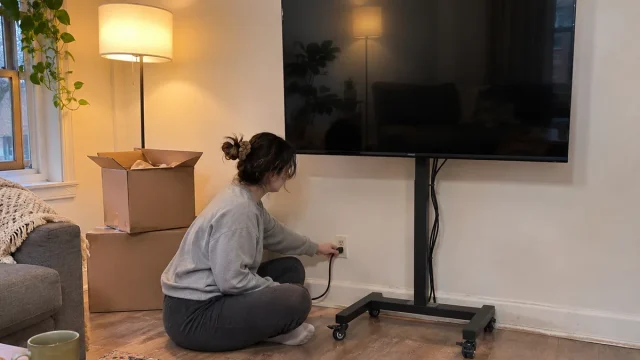
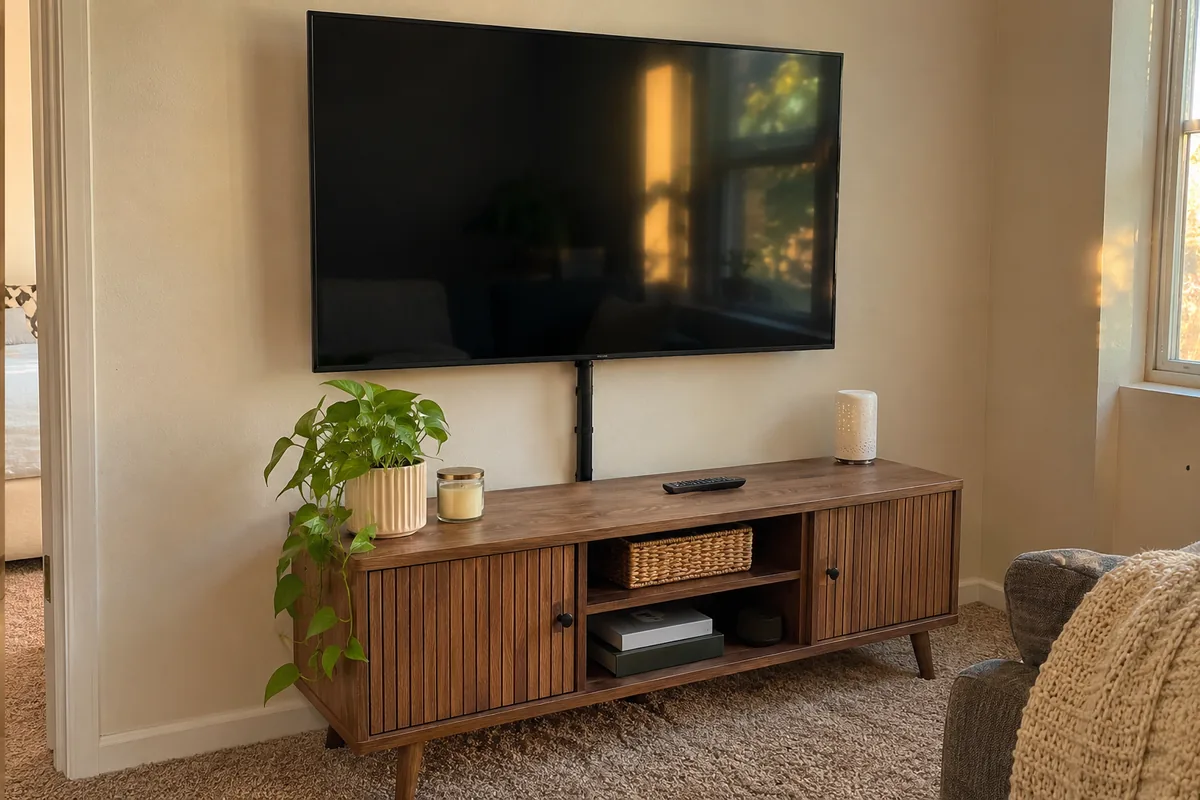
Yes, mounting a TV on the wall without drilling is doable, as long as you match the method to three things: your TV’s weight, your wall and your lease. A floor stand, a tabletop swivel base or a floor-to-ceiling tension pole leaves zero holes. A nail-in “no-stud” mount gives you the real wall-hung look with nothing but a hammer, but it leaves small pinholes. On brick or concrete, the safe move is to keep the TV off the wall entirely.
If you’re figuring out how to mount a TV without drilling, start with the lease, not the hardware. If you’ve ever stood in an empty apartment while a property manager runs a finger over the wall where your TV used to be, you know why this matters. This guide sorts every option by what it leaves behind at move-out, with weight limits and prices pulled from manufacturer specs and major US retailers (checked November 2026) plus what buyers report in reviews.
Quick answer Zero holes: a freestanding floor or easel stand (about $40 to $105), a tabletop swivel base on your console (about $21 to $60), or a floor-to-ceiling tension pole if you have a solid, flat ceiling. Pinholes only: a nail-in no-stud mount (about $23 to $49) on drywall or plaster. Typical ratings run 80 to 150 lbs depending on the model. Never for a TV: Command strips, VHB tape or suction cups. 3M rates its X-Large picture strips at 20 lbs and prints “do not hang valuable items” on the package. First step for any method: look up your TV’s weight without the stand and buy hardware rated comfortably above it. |
Key takeaways
|
Which No-Drill TV Method Fits Your Rental?
Find your situation in the left column. The middle column is the best fit and the right column is the backup if that doesn’t work.
| Your situation | Best method | Backup option |
|---|---|---|
| Lease bans any holes, even nail holes | Floor or easel stand | Tabletop swivel base |
| Drywall, landlord OK with small nail holes | Nail-in no-stud mount | Floor stand |
| Exposed brick, concrete or stone wall | Floor stand in front of the wall | Tension pole |
| Tile, glass or thin paneling | Tension pole | Floor stand |
| TV heavier than about 80 lbs | Floor stand or cart rated for it | Nail-in mount rated 110 to 150 lbs (drywall only) |
| Small studio, no spare floor space | Tension pole | Nail-in mount |
| Already own a sturdy console | Tabletop swivel base | Floor stand behind the console |
| TV moves between rooms | Rolling TV cart | Floor stand |
| Toddlers who climb | Nail-in mount (if allowed) or strapped tabletop base | Strapped floor stand |
| Budget under $40 | Tabletop swivel base | Nail-in mount |
Can You Mount a TV Without Drilling? What Renters Can and Can’t Do
You can mount a TV without drilling in almost any rental, but “without drilling” covers methods that leave very different marks. Before you buy anything, decide which of these your lease actually allows.
Many guides blur three ideas together: no drill, no studs and no holes. Here’s the plain breakdown.
No Drill, No Studs and No Holes Mean Three Different Things
| Label you’ll see | What it really means | What’s left at move-out | Examples |
|---|---|---|---|
| Zero holes | Nothing touches or enters the wall | Nothing | Floor stand, tabletop base, tension pole |
| No drill (nail-in) | Thin nails tapped in with a hammer | 8 to 32 pinholes | Hangman, Echogear EGLD1, HangSmart, Mount-It!, onn |
| No stud (anchors) | Skips studs but still uses drywall anchors or toggle bolts | Drilled holes up to about 1/2 inch | Toggle-bolt and anchor kits |
| Standard mount | Lag bolts into wood studs | Several deep holes plus patching | Most fixed, tilt and full-motion mounts |
Only the first two rows belong in a renter’s no-drill plan. If a product page says “no stud” but the box includes plastic anchors or a drill bit size, it isn’t a no-drill mount.
Do You Need a Drill to Mount a TV?
No. None of the five methods below needs a power drill. Floor stands and tabletop bases need the hex key in the box, tension poles are hand-tightened, and nail-in mounts need a hammer, a screwdriver and the included level. You only need a drill for stud mounts, anchor kits and anything going into masonry.
Renter Rules Outside the US
Lease rules decide this more than law in most places, so read yours first. One useful exception: in Victoria, Australia, renters can install picture hooks or screws for wall mounts without the rental provider’s permission, except on exposed brick or concrete walls and in heritage-listed homes, and they must restore the wall when they leave. In Canada, the UK and the EU, rules vary by province, region or country, and many tenancy agreements require written consent for any wall fixing. When in doubt, the zero-hole methods below work everywhere.
5 Ways to Mount a TV on the Wall Without Drilling (Compared)
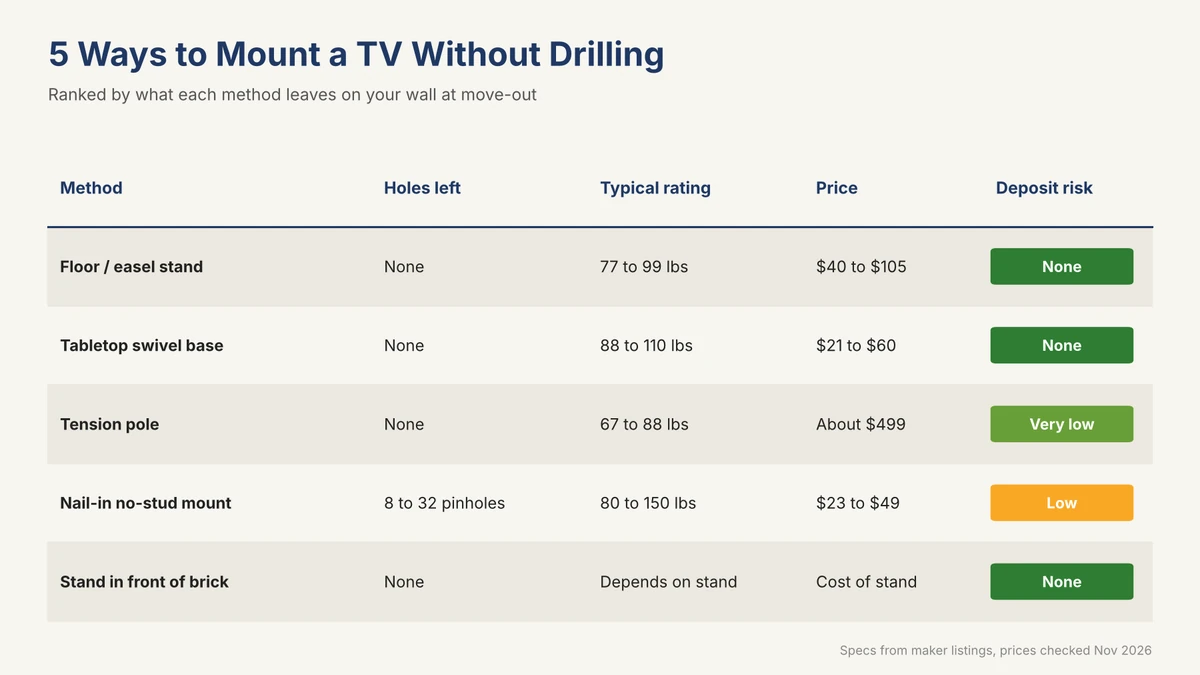
The five reliable ways to mount a TV on the wall without drilling are a floor stand, a tabletop base, a tension pole, a nail-in no-stud mount and, for masonry walls, a stand placed in front of the brick. The table shows how they compare on holes, load and cost.
| Method | Holes left | Typical rating (example models) | Works on | Price (checked Nov 2026) | Deposit risk |
|---|---|---|---|---|---|
| Floor, easel stand or rolling cart | None | 77 to 99 lbs, 23 to 70 in. | Any wall, or none | About $40 to $105; some carts about $200 | None |
| Tabletop swivel base | None | 88 to 110 lbs, 24 to 75 in. | Any wall (sits on furniture) | About $21 to $60 | None |
| Tension pole (floor to ceiling) | None | 67 to 88 lbs for home models | Any wall; needs a solid flat ceiling | About $499 regular (MOFO Pole) | Very low (ceiling scuffs) |
| Nail-in no-stud mount | 8 to 32 pinholes | 80 to 150 lbs, 26 to 100 in. | Drywall; some list plaster | About $23 to $49 | Low (spackle job) |
| Brick or concrete workaround | None | Depends on stand | Exposed brick, concrete, stone | Cost of a stand | None |
Ratings are the stated maximums for the example models named below. Always check the exact model you buy.
Weight is where people get caught out. Here’s how much TVs of the same screen size can differ, using manufacturer weights without the stand:
| 65-inch model | Weight without stand |
|---|---|
| LG OLED65C4 | 36.6 lbs |
| Samsung 65DU8000 | 46.1 lbs |
| Samsung 65QN90D | 53.4 lbs |
| LG 65QNED90T | 68.3 lbs |
That’s a 32 lb spread at the same screen size.
Method 1: Freestanding Floor or Easel Stand (Zero Holes)
A floor stand is the safest answer to how to mount a TV without drilling into the wall, because the wall never carries any load. A weighted base sits on the floor, a post rises behind or beside your console, and the TV hangs on a VESA bracket at whatever height you set.
Examples from current listings: the Perlegear PGFS09 floor stand fits 32 to 70 inch TVs up to 88 lbs with 70 degrees of total swivel. The Mount-It! MI-874 tripod stand fits 32 to 70 inch TVs up to 77 lbs and adjusts from 43 to 68 inches high ($88.19 at Staples). If you want wheels, the PERLESMITH PSTVMC04 rolling cart is listed for 23 to 65 inch TVs up to 99 lbs with four locking casters, and the Kanto MTM70PL rolling stand fits 40 to 70 inch TVs at $199.99. Easel stands look more like furniture: VIVO’s STAND-TV65AB lists 45 to 65 inch TVs up to 77 lbs, but its base is 34.8 x 24.2 inches, so measure a small room first.
Buyer complaints usually come down to a base that sticks out farther than expected or wobble from a half-tightened bolt.
Measure the floor footprint, including how far the base sticks out, and make sure doors and drawers still open.
Build the base and post on the floor and tighten every bolt fully.
With the TV face-down on a blanket, bolt the VESA arms to the back of the TV.
Lift the TV onto the post with a second person and lock the safety screws.
Set the screen height, clip the cables down the post, and attach the anti-tip strap to heavy furniture if kids or pets are around.
Best for: big TVs, brick or concrete walls, and anyone whose lease bans all wall fixings.
Method 2: Tabletop Swivel Base on Your Console (Zero Holes)
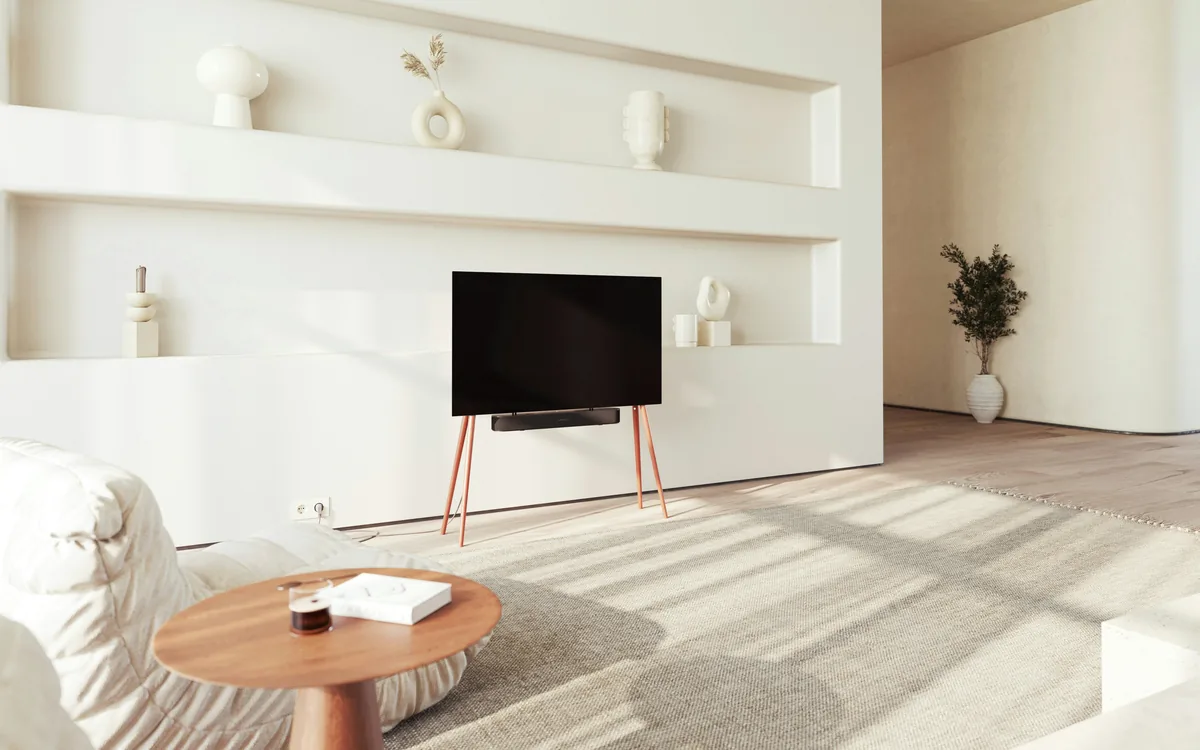
A tabletop swivel base replaces your TV’s stock feet with a single central post, so the screen sits higher, swivels and leaves room for a soundbar. It’s the cheapest zero-hole option if you already have a sturdy console or dresser.
Examples: the PERLESMITH PSTVS28B fits 32 to 60 inch TVs up to 88 lbs with 35 degrees of swivel each way (listed around $33 to $60 at Walmart). The onn tabletop stand fits 37 to 70 inch TVs and is rated to 110 lbs (about $21 at Walmart). The MountFTV 32 to 75 inch base is rated to 99 lbs (about $53 to $57). The ErgoAV 32 to 65 inch base is rated to 88 lbs ($49.99 list at Target).
Lay the TV face-down on something soft and remove the factory feet.
Assemble the post and base, and stick on the rubber pads.
Bolt the bracket to the TV, choosing holes that put the screen center near seated eye level.
Set the base on the console with no overhang, hang the TV, and strap it to the console if you have kids or pets.
Best for: small rooms and tight budgets. The limit is height on a low console.
Method 3: Floor-to-Ceiling Tension Pole (Zero Holes, Needs a Solid Ceiling)
A tension pole is a telescoping column that presses between floor and ceiling, with the TV clamped to the pole. It gives you a floating look in front of any wall, including glass, tile and brick, with a footprint of only a few inches.
Examples: the MOFO Pole is a tension-mounted pole for 32 to 70 inch TVs with a listed TV mount capacity of 67 lbs and an extension range that Best Buy Canada lists as 6.5 to 12.5 feet. The Tripp Lite DMFC3265M floor-to-ceiling mount is rated to 88 lbs for 32 to 65 inch TVs and fits ceilings up to 12 feet. Price is the catch. The MOFO Pole’s own site listed a $499 regular price in November 2026 (with a lower sale price that may not last), and maker pages list a 70 lb maximum, slightly above the 67 lb figure some retailers show. Home tension-pole TV mounts are much scarcer than floor stands. Watch for products sold as “ceiling TV mounts” with long poles: many of those screw into the ceiling, which defeats the purpose.
Measure ceiling height in two spots and confirm it’s inside the pole’s range.
Check the ceiling is flat and solid. Drop ceilings, soft tiles and steep slopes don’t work.
Put a felt or cork pad on the top plate to protect the paint.
Extend and tighten the pole until it won’t move when you push it hard at chest height.
Mount the TV with a helper, then re-check the tension the next day and again a week later.
Best for: open-plan studios, glass or tiled walls and corners. Skip it with toddlers who climb or in rooms with vaulted ceilings.
Method 4: Nail-In No-Stud Mount (How to Wall Mount a TV Without Drilling)
A nail-in no-stud mount is the only way to wall mount a TV without drilling and still get a flush, wall-hung look. A metal rail goes on the wall, small hardened nails go through angled guide holes into the drywall, and the TV hooks onto the rail.
| Model | TV size | Rated load | Nails / profile | Price (checked Nov 2026) |
|---|---|---|---|---|
| Hangman S2040-A | 26 to 55 in. | 80 lbs (UL rated) | Tiny picture nails, about 1 in. off wall | About $35 at Walmart |
| Echogear EGLD1 | 32 to 77 in. | 100 lbs | 32 nails, 1.18 in. profile | $39.99 at Best Buy |
| Mount-It! no-stud mount | 32 to 80 in. | 110 lbs | Nails, 1.2 in. profile | $45.99 at Walmart |
| onn No Stud Mount | 24 to 90 in. | 150 lbs (ETL listed) | Nails | About $36 at Walmart |
| HangSmart HSTV100 | Up to 100 in. | 115 lbs at Walmart; 150 lbs at Staples | About 8 nails per buyer reviews | $49.00 |
Notice the HangSmart row. Walmart’s listing says 115 lbs and Staples says 150 lbs for what appears to be the same model. When retailers disagree, plan around the lower number until the maker confirms in writing.
Hangman says its system works on drywall, plaster or paneled walls. Echogear’s manual is stricter: the wall must be able to hold five times the weight of the TV and mount combined, and it tells you to stop if any nail hits a metal object.
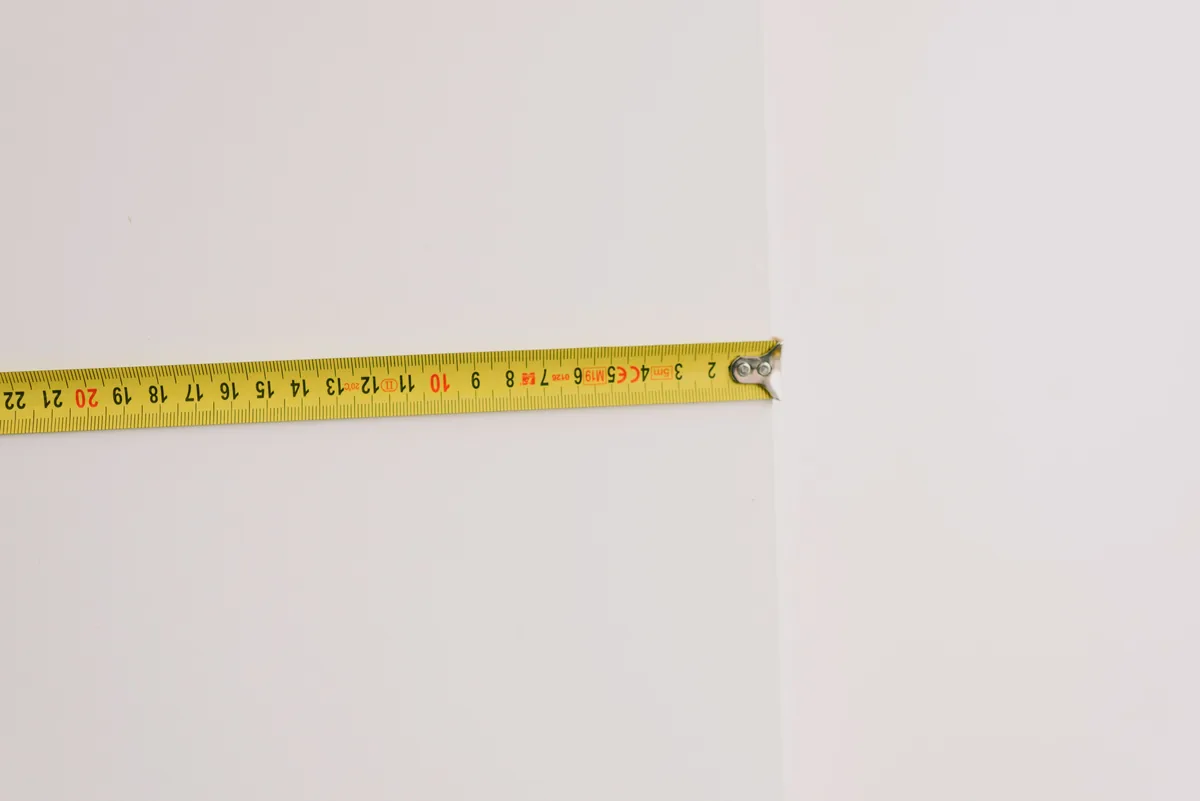
Confirm the wall is drywall (sounds hollow when you knock) and stay clear of corners, where metal corner bead sits under the paint.
Mark your height: sit on the couch and aim for the screen center around 42 inches from the floor for most living rooms.
Hold the rail level and tap each nail through its guide hole with steady, light strikes. Stop if one hits something hard.
Tug the rail firmly before the TV goes anywhere near it.
Attach the TV brackets, lift the TV on with a helper and engage the lock or safety cable.
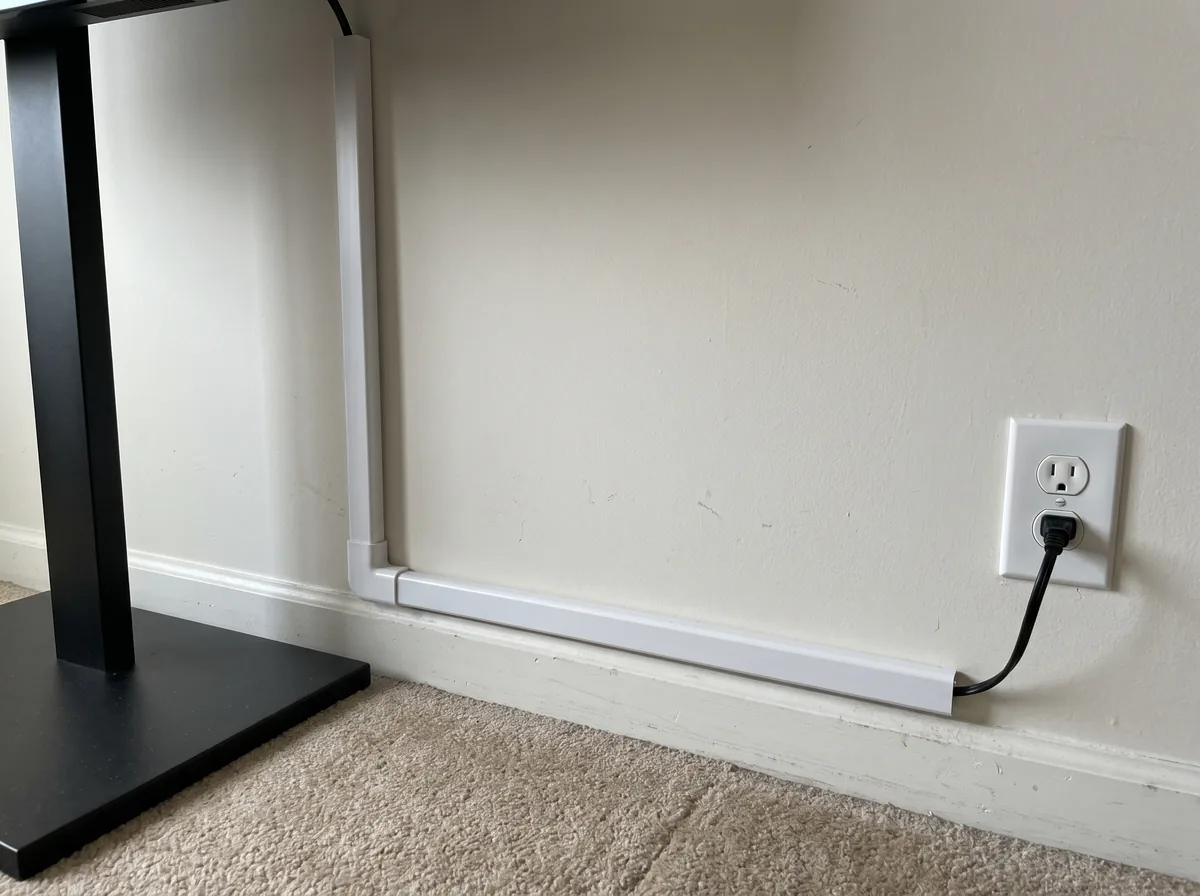
Run cables with adhesive raceway or cable clips. Slim mounts sit about 1 inch off the wall, so right-angle HDMI and power plugs help.
Buyers report bent nails when one hits a stud or corner bead, and lighter TVs sliding when the lock isn’t used.
Method 5: Brick, Concrete or Fireplace Walls: Skip the Wall
On exposed brick or concrete, the renter-safe answer is a floor stand or tension pole placed in front of the masonry. Nail-in mounts are designed for drywall, and getting anything into brick means a hammer drill.
Brick clips are tempting because they grip the brick face with no holes, but standard clips are rated around 25 lbs each and are sold for wreaths, lights and frames. Use them for a cable channel or a light picture, never the TV. Some nail-in mounts mention concrete or brick on the box, but those installs use the included screws and anchors, which means drilling and usually written consent.
How to Mount a TV Without a Drill: Choose in 3 Checks
Pick your method by running three checks in order: your TV’s weight, your wall type, then your VESA pattern and viewing height. Most bad installs skip the first one.
Check 1: Your TV’s Real Weight
Use the “weight without stand” figure from the label on the back or the maker’s spec sheet. That’s the number your mount carries. Then choose a mount or stand rated well above it, adding the weight of anything else attached, like a soundbar bracket. There’s no single industry headroom rule, so leaving a solid margin (say 25% or more) is a sensible renter habit, not a spec.
Check 2: Your Wall Type
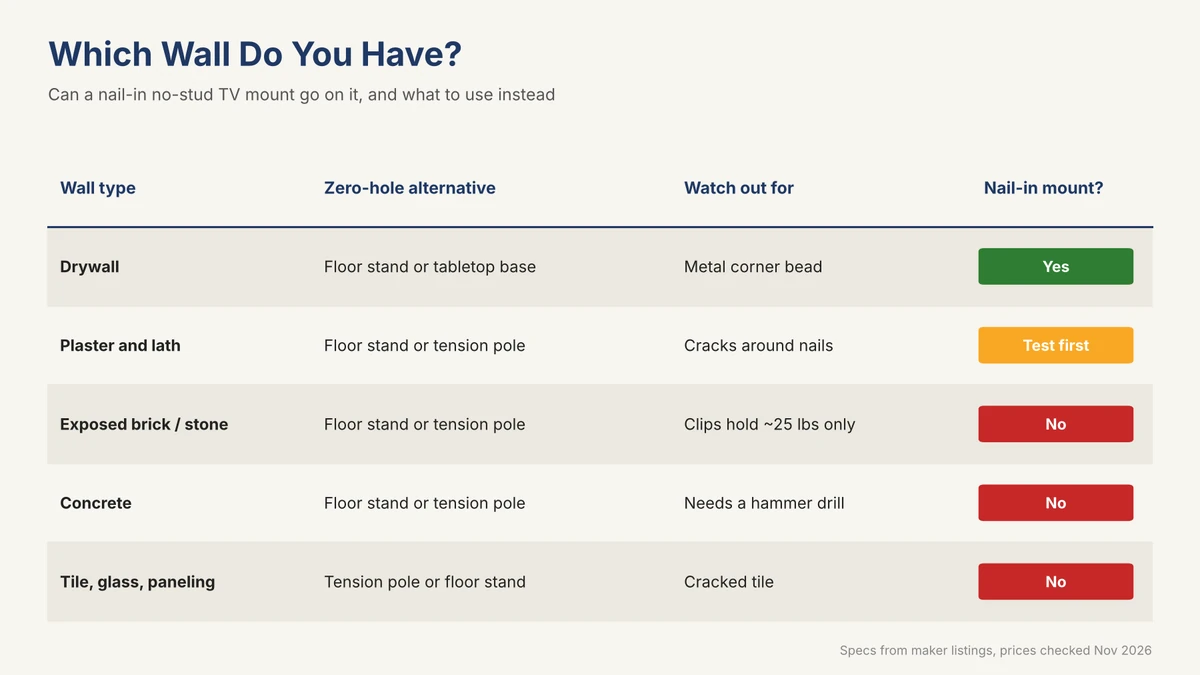
| Wall type | Nail-in mount OK? | Best zero-hole option | Watch out for |
|---|---|---|---|
| Drywall (1/2 or 5/8 in.) | Yes, within the rating | Floor stand or tabletop base | Metal corner bead, steel studs behind |
| Plaster and lath (older units) | Some brands list plaster; test a hidden spot | Floor stand or tension pole | Cracking around nails |
| Exposed brick or stone | No | Floor stand or tension pole | Brick clips can’t hold a TV |
| Concrete | No | Floor stand or tension pole | Needs a hammer drill |
| Tile, glass or thin paneling | No | Tension pole or floor stand | Cracked tile, weak paneling |
Check 3: VESA Pattern and Height
Measure the distance between the four threaded holes on the back of the TV in millimeters, for example 200 x 200 or 400 x 400, and check it against the mount’s listed VESA range. Larger 65 to 85 inch sets often use 600 x 400. For height, the common guideline is about 42 inches from the floor to the screen center for seated viewing.
How to Hang a TV Without Drilling When Kids or Pets Live There
Freestanding setups can tip. CPSC counted 451 children killed in furniture and TV tip-overs between 2000 and 2019, and 75% of those fatal incidents involved a TV. Strap the stand or base to heavy furniture, push the console against the wall, and keep remotes and toys off the TV furniture so nobody climbs for them. Most anti-tip kits cost under $20, per CPSC.
Mount TV on Wall Without Drilling and Keep Your Deposit
To keep your full deposit, pick a zero-hole method or get written permission for a nail-in mount, then photograph the wall before and after.
In most US guidance, a few small nail holes from hanging pictures count as normal wear and tear, not tenant damage. The catch is quantity. One property management firm reports a court agreed that 40 nail holes in a single wall went beyond normal wear. A 32-nail TV rail puts its holes in one tight strip, so even if each hole is tiny, it’s worth asking first.
Copy-paste landlord email Subject: TV setup question for [unit number] Hi [name], I’d like to set up my TV without drilling. My plan is [a freestanding floor stand that doesn’t touch the wall] / [a no-stud TV hanger that uses small finish nails, similar to hanging a heavy picture, with no anchors or power tools]. If you’re OK with the nail option, I’ll fill the pinholes with spackle and touch up the paint before I move out. Could you confirm in writing which option works for you? Thanks, [your name] |
How to Remove a Nail-In Mount at Move-Out
Lift the TV off with a helper and set it face-down on something soft.
Pull each nail out along the same angle it went in, using pliers. Don’t pry the rail straight off the wall.
Press a small dab of lightweight spackle into each hole and scrape it flat with a putty knife.
Let it dry, sand lightly, and dab on matching paint if your landlord gave you the color.
Photograph the wall in daylight, next to your move-in photos.
If you also used adhesive cord covers, warm the strip with a hair dryer on low and peel slowly so you don’t lift paint.
What It Costs to Hang a TV Without Drilling
The cheapest answer to how to hang TV without drilling is a tabletop base. Expect to spend roughly $21 to $105 for the hardware on most no-drill setups, with rolling carts and pole systems costing more. The table uses prices checked in November 2026 at major US retailers; they move often, so treat them as a range.
| Setup | Hardware | Extras | Move-out repair | Ballpark total |
|---|---|---|---|---|
| Tabletop swivel base | $21 to $60 | Anti-tip strap | $0 | About $21 to $80 |
| Floor or easel stand | $40 to $105 | Anti-tip strap, cable clips | $0 | About $40 to $125 |
| Rolling TV cart | About $200 | None | $0 | About $200 |
| Nail-in no-stud mount | $23 to $49 | Right-angle plugs, raceway | Spackle and touch-up paint | About $35 to $75 |
| Tension pole | About $499 regular | Ceiling or floor pad | $0 if padded | About $500+ |
Scenario: a one-bedroom with drywall, a 35 lb 55-inch TV, and a lease that bans drilling but says nothing about nails. A tabletop base under $40 keeps the deposit fully safe; a nail-in mount under $50 gets the wall look once your landlord says yes in writing.
Mistakes to Avoid When Mounting a TV Without Drilling Into the Wall
Using Command strips, tape or suction cups. They’re rated for flat frames, the biggest picture strips top out at 20 lbs, and 3M says not to hang valuable items.
Trusting screen size instead of weight. Look up the exact model’s weight without the stand.
Believing the higher number when listings disagree. Use the lowest rating you can find, and confirm with the maker.
Putting nail-in mounts on brick, concrete, tile or metal. They’re made for drywall.
Adding a tilting or extending arm to a studless rail. Pulling the TV away from the wall adds leverage. Keep no-stud setups fixed and slim.
Skipping the anti-tip strap on stands.
Lifting a big TV alone or hanging it at standing eye level. Use two people and measure height from the couch.
Frequently Asked Questions
Can you mount a TV without a drill?
Yes. Floor stands, tabletop bases and tension poles need no drill and leave no holes. Nail-in no-stud mounts need only a hammer and screwdriver and leave small pinholes in drywall.
How to hang a TV on the wall without drilling or leaving any holes?
Use a floor stand, a tabletop swivel base or a floor-to-ceiling tension pole. All three hold the TV at wall-mount height while the floor, your furniture or the ceiling takes the load, so nothing goes into the wall.
Do no-stud nail-in TV mounts really hold?
They’re rated to hold their listed weight on sound drywall, from 80 lbs for the Hangman S2040-A to 150 lbs for some larger models. Stay under the rating, keep them fixed rather than tilting, and don’t use them on brick, concrete or tile.
How to mount a TV on the wall without drilling in a brick or concrete apartment?
Keep the TV off the masonry. Put a floor stand in front of the wall or use a tension pole between a solid floor and ceiling. Brick clips hold around 25 lbs each and are meant for decor, not TVs.
Can I use Command strips to hang a TV?
No. 3M’s largest picture hanging strips are rated at 20 lbs for flat frames, and the packaging says not to hang valuable items. A TV on a bracket also pulls outward, which adhesive isn’t designed for.
How to mount TV on wall without drilling and avoid deposit charges?
A few small nail holes are usually treated as normal wear in US rentals, but a dense cluster can be argued as damage, and your lease can set stricter rules. Get written permission, then patch and paint before you move out.
More No-Drill TV and Safety Guides
The Bottom Line
Mounting a TV on the wall without drilling comes down to one honest question: what are you allowed to leave behind? If the answer is nothing, use a floor stand, a tabletop base or a tension pole. If small pinholes are fine and your wall is drywall, a nail-in no-stud mount gives you the cleanest look for under $50.
Your next step: check your TV’s weight without the stand, read the “alterations” clause in your lease, and then compare specific models in Best No-Drill TV Wall Mounts for Renters.
Sources (external links for the article)
CPSC Anchor It! tip-over report data (2000 to 2019): https://www.anchorit.gov
National Association of Realtors, What is normal wear and tear: https://www.nar.realtor/news/real-estate-news/commercial/what-is-normal-wear-and-tear
Consumer Affairs Victoria, Renters making changes to the property: https://www.consumer.vic.gov.au/housing/renting/repairs-alterations-safety-and-pets/renters-making-changes-to-the-property
3M Command picture hanging strips instructions and warnings: https://www.command.com/howtouse
Echogear EGLD1 product and manual (32 nails, 100 lb, wall must hold 5x load)