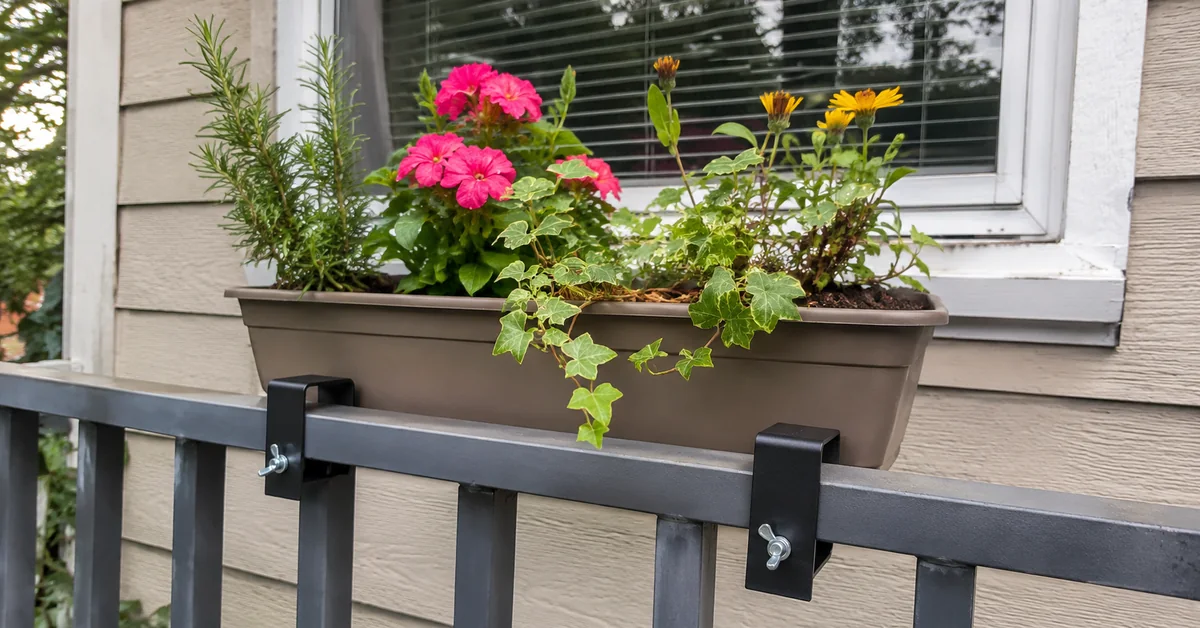
You can hang a window box without drilling, but the method has to match your wall and the weight of the planted box. Brick clips grip the mortar joints on brick, clamp-on brackets hook over a rail or windowsill, and siding hooks slide into vinyl siding seams but hold very little. This guide does the weight math first, then picks the hardware for brick, siding and rails.
Also read: No Drill Wall Mount – What Holds Without Studs or Drilling · Best No-Drill Window Shades for Renters (2026) – No Tools Window Shades Compared · Solar Panels for Apartments & Renters – Complete Guide
The renter rule: nothing drilled, nothing glued permanently to the building, and nothing you cannot take down in ten minutes on move-out day. A window box is also a falling-object risk, so the safety section below matters as much as the hardware.
Quick answer
- Weight decides everything. A 24-inch resin box full of wet soil and plants can weigh around 25 pounds, and a 36-inch box can reach 60 to 80 pounds. Most no-drill hardware is rated far below that.
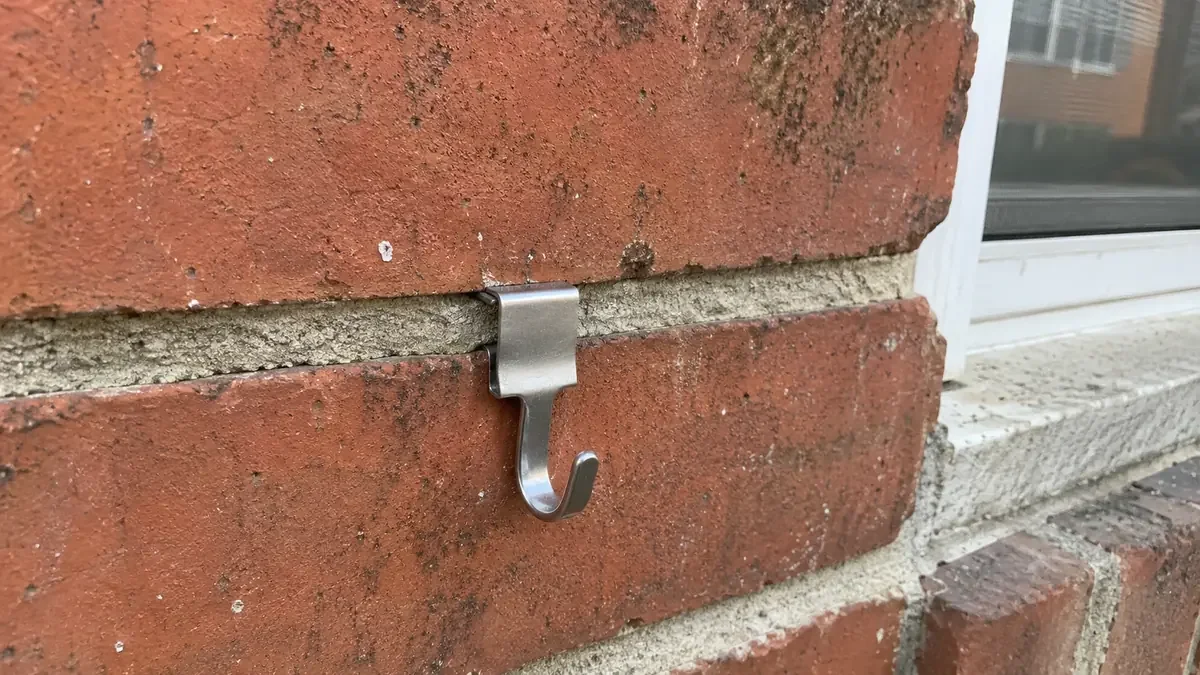
- Brick is the strongest surface for no-drill hardware if the mortar joints are recessed. Brick clips are cheap and removable.
- Rails and sills take clamp-on brackets. This is the practical middle ground.
- Vinyl siding is the weakest surface. Siding hooks hold only a few pounds each, so they suit very light boxes at most.
- Safest option: sit the box on a flat sill or balcony floor, with no hanging hardware at all.
Every No-Drill Window Box Method Compared
Ratings come from manufacturer listings, so check the exact product. Costs are typical ranges (checked November 2026).
| Method | Best surface | Typical weight limit | Renter-friendly? | Typical cost |
|---|---|---|---|---|
| Brick clips | Brick with recessed mortar | Often rated around 30 lb per clip | Yes, fully removable | $3 to $10 per pack |
| Vinyl siding hooks | Vinyl siding | Often around 2.5 lb per hook | Yes, but too light for planted boxes | $5 to $10 per pack |
| Clamp-on rail brackets | Deck rails, balcony rails, some sills | Check the pair’s rating, often 15 to 20 lb per pair for small models | Yes, clamp on and off | $25 to $50 per pair |
| Window box with clamp kit | Sill or rail | Check the kit’s rating | Yes | $60 to $100 |
| Suction cups with hooks | Smooth glass only | Light boxes only | Yes | $10 to $25 |
| Adhesive hooks or strips | Smooth painted trim, glass | A few pounds per hook | Light boxes only | $5 to $15 |
| Freestanding or sill-sitting box | Any flat sill or balcony floor | No hardware limit | Yes, the zero-risk option | Box price only |
One glance tells the story. Brick clips are the cheapest hardware strong enough for a planted box, rail brackets are the practical middle ground, and siding hooks, suction cups and adhesive are for very light boxes only.
The Weight Math Most Guides Skip (Do This First)
Before you buy anything, work out what the box will actually weigh. Plan for the wet weight, not the dry weight.
A simple rule – assume the soil weighs as much as water
Water weighs about 62 pounds per cubic foot. Wet potting mix is lighter, but if you plan for water weight, a rainy week cannot catch you out.
Worked examples
- A 24-inch resin box holding about 3 gallons. That is roughly 0.4 cubic feet. Filled to 80 percent, soil is about 0.32 cubic feet. At 62 lb per cubic foot, that is about 20 lb of soil. Add about 2 lb for the box and 3 lb for plants: roughly 25 lb worst case.
- A 24-inch self-watering box holding about 4 gallons. That is about 0.53 cubic feet, or 0.43 at 80 percent fill. Soil is about 27 lb, plus about 7 lb for a heavier box with a reservoir and 4 lb of plants: roughly 38 lb.
- A 36-inch box. Roughly 0.8 cubic feet of soil is about 50 lb before the box and plants, so a figure of 60 to 80 lb is realistic.
Cut the weight with filler
You do not need 8 inches of soil for petunias, pansies or herbs. Fill the bottom 2 to 3 inches of the box with lightweight filler such as empty plastic bottles, packing peanuts or upside-down nursery pots, and put soil only on top. That can cut soil volume by about a third.
The rule that follows
Buy hardware rated for at least double the wet weight. If the box weighs 25 lb wet, the hardware should be rated for 50 lb or more. That one rule eliminates most of the hardware on the market, which is the point.
How to Choose – Brick, Siding or Rail?
| Surface | Best method | Watch out for | Max sensible box |
|---|---|---|---|
| Brick with recessed mortar (joint set back about 1/8 inch or more) | Brick clips | Painted brick, so test first | 24 in, resin |
| Brick with flush mortar | Rail or sill brackets, or a freestanding box | Clips slide off, and adhesive will not hold rough brick | 24 in, resin |
| Brick veneer (thin, decorative) | Freestanding only | Veneer can peel under load | Sill-sitting box |
| Vinyl siding | Rail or sill brackets | Siding is not structural | Light box on brackets |
| Wood siding | Rail or sill brackets | Do not puncture siding | 24 in, resin |
| Deck or balcony rail | Clamp-on rail brackets | Measure the rail first | 24 in, resin |
| Windowsill (deep enough) | Clamp-on sill brackets or sit the box on the sill | The sill must be level and as deep as the box | 24 in, resin |
| Smooth glass | Suction cups with hooks | Heat and cold weaken suction | Small, light box |
| Stucco | Rail or sill brackets, or freestanding | Stucco crumbles under point loads | Sill-sitting box |
How to tell what you have. Run a finger across a mortar joint. If the cement sits back from the brick face and you feel a groove, the mortar is recessed and clips can grip. If the joint is flush, clips cannot hold. For brick veneer, ask the landlord, since veneer is glued on and not designed to carry hanging loads.
How to Hang Window Boxes on Brick Without Drilling
Brick is the best surface for no-drill hanging, because clips are cheap, strong and removable. Here is a version that respects the weight math.
What you need
- A light resin box with a rim lip, about 24 inches
- Brick clips rated for the load, enough to have a wide margin (many guides suggest about two clips per 10 lb of load, so six clips for a 25 lb box)
- Potting mix and lightweight filler
- A level and a helper. Do not do this alone on a ladder.
Steps
- Check the mortar. Run your finger along the joints under the window. You need a recess of about 1/8 inch or more. If the mortar is flush, stop and use the rail or sill method.
- Measure the brick. Standard bricks are roughly 2-1/4 to 2-1/2 inches tall. Check the clip’s size range.
- Place the clips. For a 24-inch box, put three clips across the top row of bricks and three across the row below, spaced evenly.
- Test empty. Hang the empty box and pull down firmly with both hands. If any clip shifts, re-seat it. If it shifts twice, move that clip to a different brick.
- Fill the box in place only if it holds. Add filler first, then soil, then plants. Hang it last if you can, with a helper.
- Recheck after the first rain and again weekly during the first month.
How to Hang a Window Box on a Rail or Windowsill
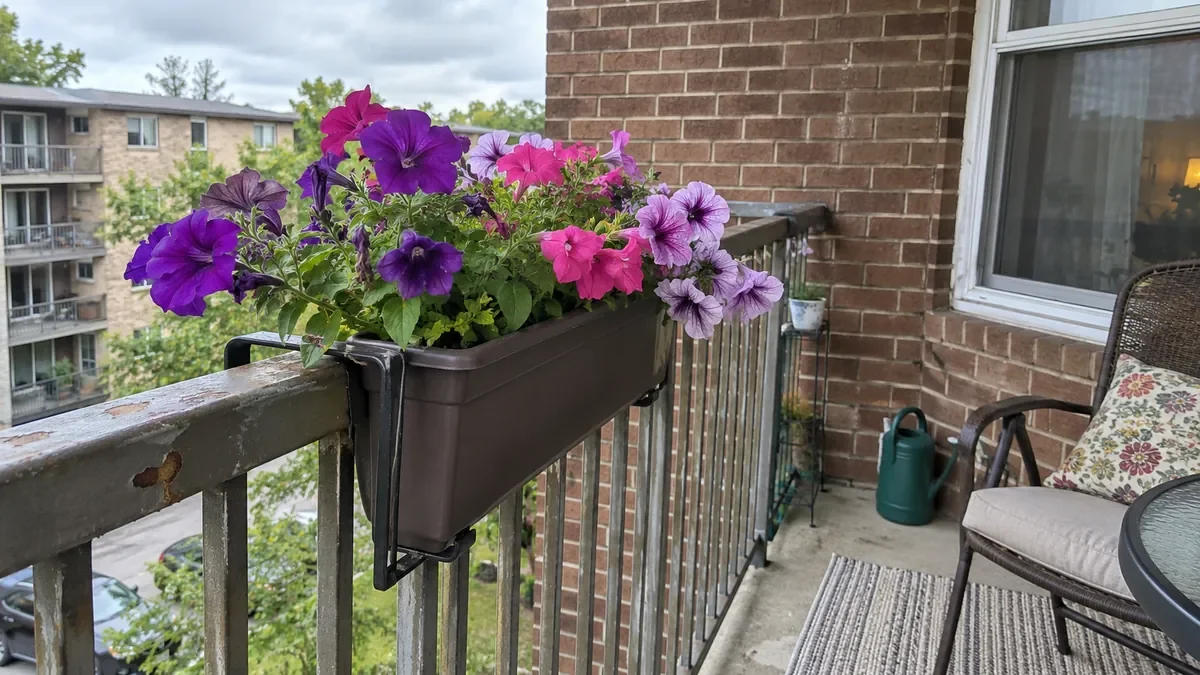
Clamp-on brackets are the most flexible renter solution because they work on balcony rails, deck rails and some sills.
- Measure the rail or sill. Most clamps fit rails up to a stated width. Check the width, thickness and shape (round or square).
- Check the rating. Use the pair’s rating, not a single bracket’s, and keep the load at half of it.
- Fit the brackets to the rail at both ends of the box, evenly spaced, and tighten by hand until firm.
- Slide the empty box in and check it is level.
- Add soil and plants while the box is in place only if you can reach it safely.
- Add a safety line. A cable tie or small strap from the box to the rail gives a second point of support if a bracket slips.
What About Vinyl Siding Hooks, Suction Cups and Adhesive?
Siding hooks slide into the seam between panels and leave no hole, but the ratings are low. At around 2.5 lb each, you would need many of them for one planted box, and siding is not a structural surface, so they suit only a small, very light box if at all. Use rail or sill brackets instead.
Suction cups hold on smooth glass but weaken with heat, cold and dirt. Treat them as a last resort for a small, light pot. Adhesive hooks and strips work on smooth painted trim for a few pounds. Neither belongs near a box full of wet soil.
How to Hang Window Boxes Without Drilling – The Short Version
If you want the whole process in one place, this is the order that works for most rentals.
- Weigh the planted box on paper. Use the worked examples above and plan for wet weight.
- Identify the surface. Brick with recessed mortar, rail, sill, siding or glass decides the method.
- Choose hardware rated for double the weight, or choose a sill-sitting box if nothing fits.
- Pad the contact points so rails, sills and brick are not scratched or chipped.
- Hang the empty box and test it by pulling down firmly.
- Add a safety strap or cable to a second fixed point.
- Fill, plant and recheck after the first watering and the first rain.
A typical scenario shows why the order matters. You rent a third-floor flat with a narrow balcony rail and want herbs and trailing flowers. A 24-inch resin box on a rated rail bracket pair, filled with a third lightweight filler, stays well under the hardware’s limit. The same box on siding hooks would fail the first time it rained. Doing the math first is what keeps the box up.
Lighter Plants, Lighter Soil, Lower Risk
You control the weight more than you think. The plants and the mix you pick change how heavy the box gets.
- Use a light potting mix. Mixes labeled for containers are lighter than garden soil. Avoid heavy garden soil or topsoil in any hanging box.
- Choose shallow-rooted plants. Petunias, pansies, trailing ivy, thyme and many herbs do well in a few inches of soil, so you need less of it.
- Skip big, deep-rooted plants. Tomatoes and shrubs need deep soil and become top-heavy.
- Use a self-watering box carefully. The reservoir adds weight when full. Count it in your math.
- Water in the morning, in small amounts, rather than flooding the box. Overwatering adds weight and rots roots.
- Pick a box with drainage holes and a drip tray that fits, so water does not run down the wall or onto neighbors below.
A quick comparison of common box materials, using typical figures:
| Box material | Weight empty | Notes |
|---|---|---|
| Resin or plastic | Light, a few pounds | Best choice for hanging, and many have a rim lip for brackets |
| Fiberglass | Light to medium | Strong and light, often more expensive |
| Wood | Medium | Looks good but swells and rots, and gets heavy when wet |
| Metal or coir-lined metal | Medium | Can get hot in the sun and dry the soil faster |
| Ceramic or concrete | Heavy | Keep these on the floor, never hanging |
Seasonal Care That Protects Your Hardware and Deposit
A window box is not a set-and-forget item. A few habits keep it safe and keep the wall clean.
- Spring: check clips and brackets before you plant. Clean off rust and re-seat anything that has shifted over winter.
- Summer: water more often, but check the weight. A box that was fine in May with new plants may be heavier in July with full growth and daily watering.
- Autumn: cut back plants or swap to lighter ones. Wet leaves and fall rain add weight too.
- Winter: empty the box if frost or snow is likely. Frozen soil is heavy and can crack a resin box. Store the hardware indoors if it rusts.
- Always: wipe off water stains and soil splashes on the sill and wall, since staining is a common reason for deductions.
If you are unsure if your building allows exterior boxes at all, ask in writing before you buy. A quick email costs nothing, and a refusal on paper is better than a surprise at move-out.
Quick Decision Guide – Which Setup Fits Your Rental?
| Your situation | Best setup | Why |
|---|---|---|
| Balcony with a sturdy rail | Rated clamp-on brackets and a 24-inch resin box | Moves with you and fits most rails |
| Brick wall with recessed mortar | Several brick clips and a light box, plus a safety line | Cheap and strong if the mortar is right |
| Vinyl or wood siding, no rail | Box sitting on a sill or a floor stand | Siding cannot carry a load |
| Deep, level windowsill | Box sitting on the sill with a restraint strap | No hardware at all |
| Third floor or higher over a walkway | Sill-sitting box or no box | The fall risk is too high |
| Short lease, low budget | Small pots on a ledge | Cheapest and safest |
| Shared balcony | Ask the landlord first | Shared areas often have separate rules |
Safety – A Window Box Is a Falling-Object Risk
A planted box several floors up can injure someone below if it falls. Treat it as a safety item, and a decoration.
- Never hang a box over a sidewalk, entrance or shared walkway unless your building allows it and the hardware is rated with a large margin.
- Use a backup. A safety cable or strap from the box to the rail or frame catches it if a clip slips.
- Water carefully. A watered box is heavier than it was when you hung it.
- Check after storms and wind. Look for shifting clips and loose brackets.
- Know your building’s rules. Some buildings ban boxes on exterior walls or balcony rails. Ask first.
- Consider a sill-sitting box. A box on a flat sill or the balcony floor cannot fall.
What Does It Cost to Hang a Window Box Without Drilling?
Typical ranges, to confirm live (checked November 2026):
| Item | Typical cost |
|---|---|
| Light resin box, 24 inch | $15 to $40 |
| Brick clips, set of six | $8 to $20 |
| Clamp-on rail brackets, pair | $25 to $50 |
| Window box with bracket kit | $60 to $100 |
| Potting mix, 1 cubic foot | $10 to $20 |
| Safety cable or straps | $3 to $8 |
Example: a 24-inch box on six brick clips with soil and filler lands around $40 to $80. A box on rail brackets runs around $60 to $120. Cutting soil with filler lowers both weight and the cost of soil.
Landlord, Lease and Deposit
- Read the lease for rules on exterior fixtures, balcony items and anything attached to the building. Ask in writing if unsure.
- Brick clips can chip old or soft mortar and brick. Test gently, and avoid clips on crumbling mortar.
- Clamp-on brackets can scratch painted rails. Pad the contact points with felt or rubber.
- Water can stain. Use drip trays and watch overflow, since staining below or on the sill can cost your deposit.
- Photograph the wall, rail and sill before and after.
- Plan removal. Take the box down first, then the hardware, then rinse and wipe the area.
How to Take It Down at Move-Out
- Empty the soil into bags or a bin, since a full box is heavy to lift.
- Remove the box and safety line, then the brackets or clips.
- Wipe the rail, sill or brick and check for scratches, chips or marks.
- Photograph the finished area in daylight.
Mistakes to Avoid When Hanging Window Boxes
- Planning for dry weight instead of wet weight.
- Using siding hooks, adhesive or suction cups for a full box.
- Using brick clips on flush mortar or brick veneer.
- Skipping a backup cable or strap.
- Hanging a box over a walkway.
- Forgetting to pad rails and sills.
- Overfilling with soil when filler would do.
- Not rechecking after the first rain.
Questions
Frequently asked questions.
How do I hang a window box without drilling?
Match the hardware to your wall: brick clips for brick with recessed mortar, clamp-on brackets for rails and sills, or sit the box on a flat sill. Work out the wet weight first and choose hardware rated for double it.
How do I hang window boxes on brick without drilling?
Use brick clips that grip the mortar joints, as long as the joints are recessed about 1/8 inch or more. Use several clips, test the empty box by pulling down, and add a safety line.
Can I hang a window box on vinyl siding?
Siding hooks leave no hole, but they hold very little, so they suit only a light box at most. Rail or sill brackets, or a sill-sitting box, are safer.
How heavy is a window box when it’s full?
A 24-inch resin box can reach about 25 lb with wet soil and plants, and a 36-inch box can reach 60 to 80 lb. Self-watering boxes weigh more.
Will brick clips damage my wall?
They shouldn’t mark sound mortar, but they can chip old or soft mortar. Test gently and avoid crumbling joints.
What is the safest way to have a window box in a rental?
Put the box on a flat sill or balcony floor, or use rated clamp-on brackets with a safety strap. Avoid hanging over walkways.
Conclusion – Your Next Step
How to hang window boxes without drilling comes down to three checks: the wet weight of the box, the surface you are hanging it on, and a backup in case something slips. Weigh your setup, test the empty box and add a safety line before you plant. For frames and lighter items, read Renter-Friendly Ways to Hang Pictures & Art Without Nails. For other brick walls, see How to Hang Things on a Brick Wall Without Drilling, and for furniture, see How to Secure a Bookshelf to the Wall Without Drilling. For tools, see Tools Every Renter Needs.
Sources: manufacturer ratings for brick clips, siding hooks and rail brackets; the weight of water per cubic foot as a conservative planning figure; tenant guidance on damage and deposits from state and provincial agencies. Checked November 2026.