
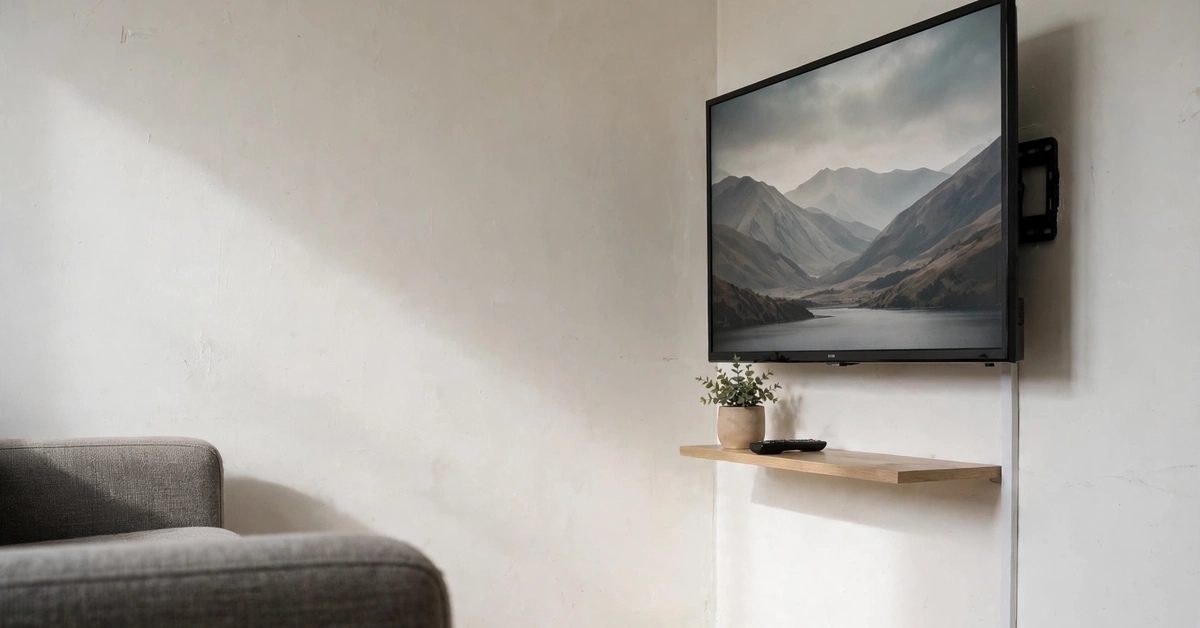
A no drill wall mount lets you put a TV, a shelf or a row of hooks on a rental wall without drilling into studs. The phrase covers three very different things, though, and only one of them is designed to hold a television. A nail-based studless mount spreads a load across many small angled nails, adhesive mounts hold light items on smooth paint, and zero-wall-contact options such as floor stands hold the most with no deposit risk.
Also read: Smart Homes for Rent – What to Look For (and How to Make Any Rental Smart) · What States Allow Plug-In Solar? 2026 State-by-State Tracker
The renter rule for this guide: nothing you mount should need a drill, a stud finder or a hole bigger than a nail, and everything should come down at move-out with spackle or less. If a mount cannot meet that test, it does not belong here.
Quick answer
- TV: nail-based studless mounts are the only wall-mounted option built for a TV without studs. Their ratings come from the makers, so choose one rated at well over your TV’s weight. A floor or tabletop stand is the safest for your deposit.
- Light shelves and small items: adhesive mounts hold a few pounds on smooth, cured paint. They are for display weight, not books or heavy mirrors.
- Real weight: floor stands, leaning shelves and tension poles use no wall at all.
- “No gap wall mount” is not a drill-free product. It refers to a flush mount for a specific TV, covered below.
- Adhesive alone never holds a TV. No home-use strip or tape is rated for one.
What a No Drill Wall Mount Actually Means
Search for a no drill wall mount and you will see three products wearing the same label. They are not interchangeable, and each holds a different weight on a different wall.
- Nail-based studless mounts. Metal plates fixed to drywall with many small nails driven at downward angles. No drill, no stud finder, no anchors. The plate spreads the load over a wide patch of drywall. Holes left at move-out are small nail holes that spackle fills.
- Adhesive mounts. Foam strips and pads such as picture strips, hooks, ledges and caddies. They suit frames, plants and light decor. Capacity is low and the bond depends on the paint.
- Zero-wall-contact mounts. Floor TV stands, tabletop stands, tension poles, leaning shelves and over-door racks. Nothing is attached to the wall, or the piece only leans on it.
Most renters need one item from group one or two plus one from group three. The rest of this guide helps you match the load to the mount, install it without a drill and take it down without losing your deposit.
Every No Drill Wall Mount Type Compared
Capacities below are typical ranges from manufacturer listings. Always check the exact product you buy.
| Mount type | What it holds | Typical rated capacity | Wall it needs | Damage at move-out | Best for |
|---|---|---|---|---|---|
| Nail-based studless TV mount | TVs, roughly 19 to 100 inches depending on model | About 80 to 150 lb, varies by model | Smooth drywall (some list wood, brick or concrete) | Small nail holes, spackle | A TV on drywall |
| Adhesive picture ledge | Frames, small plants | Around 5 lb total | Smooth painted drywall | None if removed correctly | Light display |
| Adhesive caddy or hooks | Toiletries, keys, small items | About 4 to 7.5 lb | Smooth drywall, tile, glass | None if removed correctly | Bathroom, entryway |
| Adhesive picture strips | Frames, posters | About 1 to 20 lb per set | Smooth painted drywall only | None if removed correctly | Pictures |
| Tension pole shelf | Toiletries, plants, light items | Often around 7 lb per shelf | Floor and ceiling | None | Bathrooms, corners |
| Leaning or freestanding shelf | Books, decor, plants | Often 10 to 50 lb per shelf | Any wall (it leans) | None, maybe a scuff | Real weight |
| Over-door rack | Towels, shoes, pantry items | Often around 8 lb per basket | A door, not a wall | None | Closets, bathrooms |
| Floor TV stand | TVs up to roughly 65 to 70 inches | Often 60 to 110 lb | None | None | Big TVs, zero deposit risk |
| Tabletop TV stand | TVs up to roughly 55 to 65 inches | Often 40 to 80 lb | None | None | Bedrooms, small TVs |
The pattern is the point: the heavier the load, the less the wall should be involved. A TV on a nail-based studless mount can be a reasonable choice. A shelf of books on adhesive strips is a failure waiting for a warm afternoon.
Wall Mount No Stud – How Nail-Based TV Mounts Work
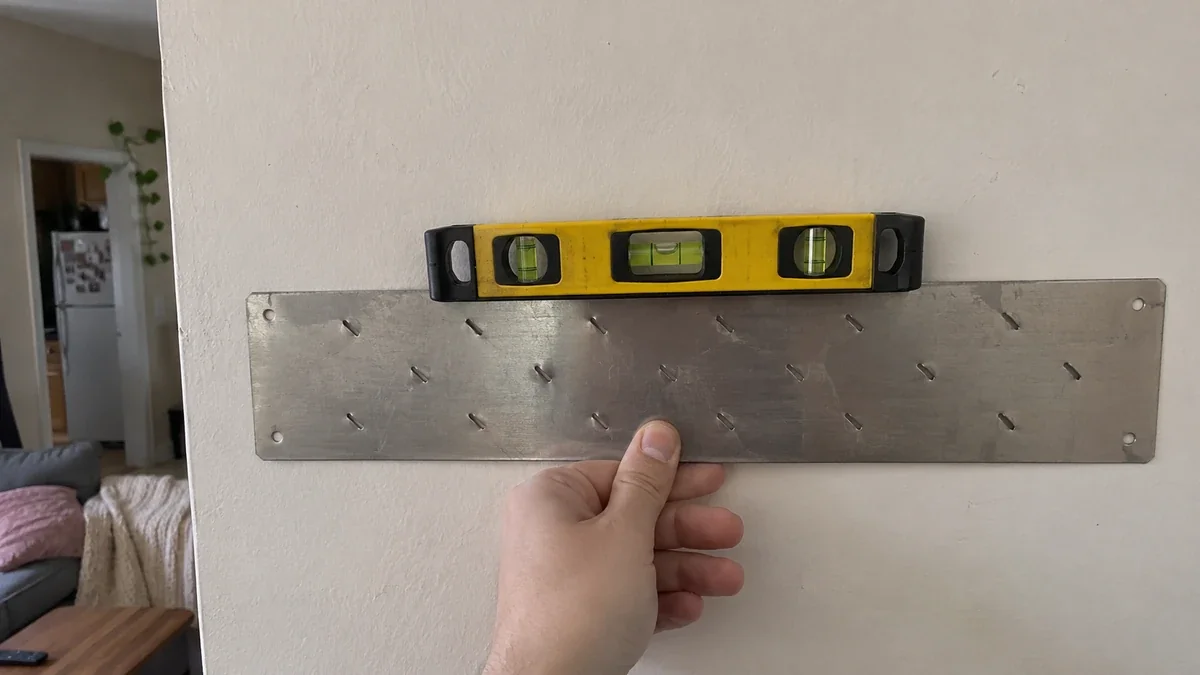
“Wall mount no stud” is what renters type when they want a TV on the wall and the lease says no drilling. The products that answer it are nail-based studless mounts. They are often misunderstood, because they are not adhesive. They are a mechanical fixing.
A traditional TV mount hangs on lag bolts driven into wooden studs. A studless mount replaces those bolts with a wide steel plate and dozens of small nails, driven at an angle into the drywall. The angle and the spread of nails across the plate distribute the TV’s weight over a large area instead of a few points.
What to compare when you shop:
- Weight rating versus your TV’s weight. Pick a mount rated at least double what your TV weighs. Check the TV’s spec page for its weight without the stand.
- VESA pattern. The hole pattern on the back of the TV must fit inside the mount’s supported range.
- TV size range. Makers list a minimum and maximum screen size.
- Wall types. Some mounts are drywall-only and say not to use them on plaster, brick or concrete. Others list more surfaces. Read the manual.
- Distance from the wall and tilt. Most are fixed or have only a few degrees of tilt.
- Locking mechanism. A safety lock or screw that holds the TV in place is worth having.
Three honest limits apply to every studless mount. First, they are fixed or near-fixed, with no swivel arm, because an arm would lever the weight away from the wall and defeat the load-spreading design. If glare is a problem, a different wall or a floor stand is the answer. Second, they depend on the drywall being sound. Soft, damp or crumbling drywall can fail. Third, the ratings are the makers’ own figures, so leave a wide safety margin and do not treat them as guarantees.
Because these mounts use a lot of small nail holes, check your lease. Many leases ban drilling and anchors but say less about small nails, while a few ban holes of any kind. If yours does, use a stand.
No Gap Wall Mount – What It Really Is
“No gap wall mount” sounds like another type of no-drill mount. It is not. The phrase usually refers to a flush-mount bracket made for Samsung’s The Frame TV, which lets the screen sit flat against the wall like a framed picture. Check Samsung’s current product page for what ships with your model, because the details change by size and year.
This matters because renters search for a no gap wall mount hoping for a drill-free Frame install. The honest answer depends on your setup:
- Smaller models may come with a tabletop stand that leans the TV on a dresser or console. That means no wall contact at all.
- Larger models use a standard VESA pattern, so a studless mount rated for the TV’s weight and size range may fit. Check the weight and VESA before you buy.
- Do not use adhesive strips on any TV. Strips are rated for smooth, flat-painted drywall and light loads, and a TV is neither. A failed bond with a television attached is an expensive mistake.
If you do not own a Frame TV, no gap wall mount is not a product category you need. The mounts in the rest of this guide cover ordinary TVs.
How to Choose the Right No Drill Wall Mount
Choosing is a three-step check: weigh the load, check the wall, then check the lease. Skip any step and you will buy the wrong mount.
Step 1 – Weigh the load
Weigh the TV or the fully loaded shelf, not the empty shelf. A mid-size TV can weigh 25 to 40 lb, a shelf with ten paperbacks 15 to 20 lb, and a framed 24×36 print 5 to 8 lb. Then apply a 2x rule and buy a mount rated at double the load.
Step 2 – Check the wall
| Wall type | Nail-based studless mount | Adhesive mount | Zero-wall-contact |
|---|---|---|---|
| Smooth painted drywall | Yes, best case | Yes, best case | Yes |
| Textured or orange-peel paint | Possible, with care | No, bond is unreliable | Yes |
| Old hard plaster | Check the manual, some are drywall-only | No, often too uneven | Yes |
| Brick (indoor) | Only if the mount lists brick | No, makers say not for brick | Yes |
| Concrete or cinder block | Only if the mount lists it | No | Yes |
| Tile | No | Yes, for products made for tile | Yes |
| Glass | No | Suction or specific adhesives | Yes |
| Wallpaper | No | No, it can pull the paper off | Yes |
| Fresh paint (under 7 days) | Wait for cure | Wait at least 7 days, longer is safer | Yes |
Step 3 – Check the lease
Read the alterations clause before you buy. Most leases ban drilling and anchors. Far fewer ban small nails, and almost none ban adhesive strips or freestanding furniture. If yours bans holes of any kind, choose a stand. When in doubt, ask in writing.
How to Install a Nail-Based No Stud TV Mount
This install takes 15 to 30 minutes, one person (two for a large TV), a hammer, a level and a pencil. Always follow your mount’s manual, which overrides this general outline.
- Weigh and measure the TV. Check weight and VESA on the manufacturer’s spec page. Both must sit inside the mount’s rating. If either does not, buy a different mount.
- Pick the wall and height. The center of the screen usually sits around eye level from your seat. Mark the spot with painter’s tape and view it from the seat before committing.
- Check the drywall. Press the wall with your palm. It should feel solid, not soft or spongy. A dull thud over a wide area can mean damp or damage. If the wall feels wrong, use a stand.
- Mark the plate position. Hold the wall plate at the marked height, level it, and mark every nail hole with a pencil. Count the holes against the manual.
- Drive the nails. Tap each nail in at the angle the manual shows. A half-driven nail carries no load and a bent nail must be replaced.
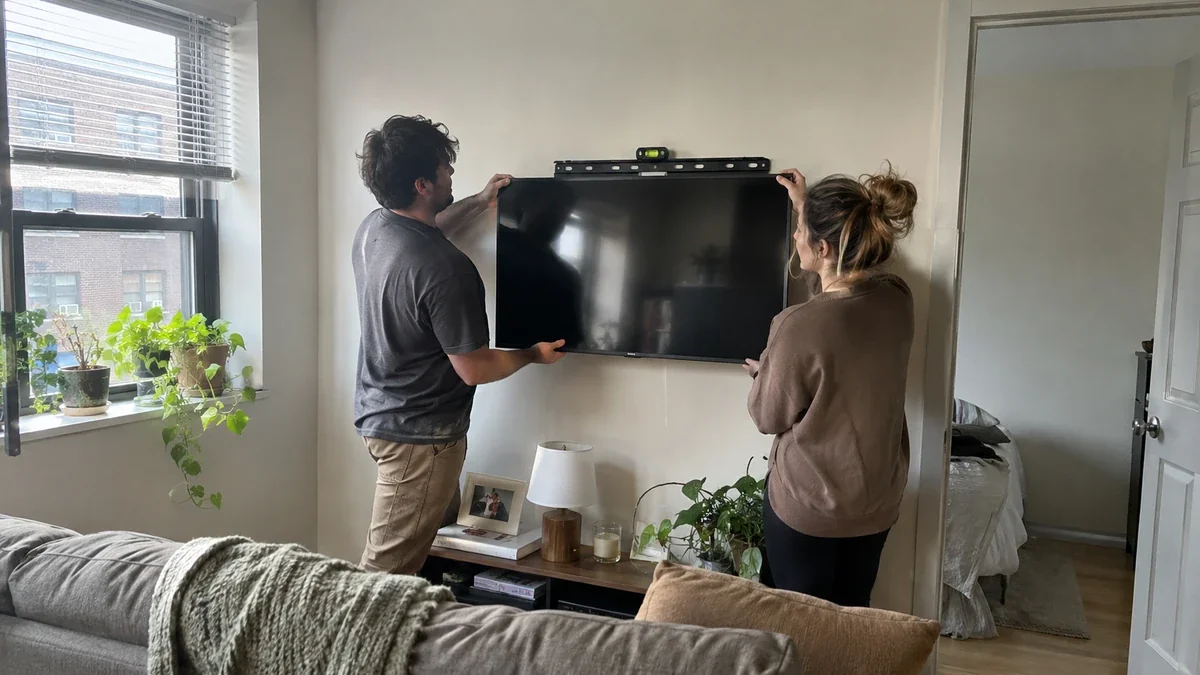
- Attach the brackets to the TV. Fit the TV brackets with the supplied bolts and spacers, matching the VESA holes. Lift the TV onto the plate. A second person helps here, especially over 55 inches.
- Lock and test. Engage the lock, then pull gently down and forward on the bottom edge. It should not move or creak. Check level, connect cables and recheck after an hour.
How to Install an Adhesive Ledge or Hook
Adhesive mounts fail in the prep, not in use. Every step below is prep.
- Clean the wall with rubbing alcohol, not household cleaner, which can leave residue. Let it dry completely.
- Wait for the paint. Do not stick anything to paint under a week old. Longer is safer.
- Press each strip firmly for the time shown on the pack, then press the mount onto the strips and hold it again.
- Wait before loading. Adhesive needs time to reach full strength. Loading it early is a common reason for falls.
- Load to half the rating. A 5 lb ledge should carry 2 to 3 lb of display items in a real apartment.
For frames, see Renter-Friendly Ways to Hang Pictures & Art Without Nails. For cords, see How to Hide Cords on Walls Without Drilling.
What Do No Drill Wall Mounts Cost?
Prices change often and vary by seller, so these are typical ranges to confirm live (checked November 2026).
| Item | Typical cost |
|---|---|
| Nail-based studless TV mount | $30 to $70 |
| Adhesive picture ledge | $15 to $25 |
| Adhesive caddy or hooks | $4 to $14 |
| Tension pole shelf | $25 to $60 |
| Tabletop TV stand | $20 to $60 |
| Floor TV stand | $60 to $200 |
| Leaning or freestanding shelf | $40 to $120 |
Example setups
- A mid-size TV on the wall: a studless mount at about $40 to $60 plus a few dollars of spackle for move-out. Roughly $50 to $70 total.
- A living-room wall: a studless TV mount, an adhesive ledge for two light frames and a caddy for the remote and cables. Roughly $80 to $120.
- The zero-wall-contact setup: a tabletop TV stand plus a leaning shelf for books and decor. Roughly $60 to $180 depending on the shelf. Nothing touches the wall, so no deposit risk.
A drilled stud mount costs about the same, but it leaves bigger holes and often a repair charge.
Which No Drill Wall Mount for Which Job?
Use this quick guide when you already know what you want on the wall.
| Job | Best fit | Why |
|---|---|---|
| Mid-size or large TV in a living room | Studless TV mount or floor stand | Built for the weight, or no wall use at all |
| Bedroom TV | Tabletop stand or studless mount | A stand keeps the wall untouched |
| Framed art | Picture strips on smooth paint | Light, removable, no holes |
| Heavy mirror | Lean it on the floor | Gravity is a better hanger than adhesive |
| Bathroom storage | Tension pole or tile-safe caddy | Steam weakens most adhesive |
| Books | Freestanding shelf, secured against tipping | Books are heavier than they look |
| Cables | Adhesive cord clips | See the cord guide |
| Coats and bags | Over-door hooks | Uses the door, not the wall |
Safety Rules for Any Mount Without Studs
A few rules apply to every option in this guide:
- Keep heavy things low. If a mount fails, a TV at eye level falls a shorter distance than one above a sofa or bed. Never mount a TV above a crib or bed.
- Keep children and pets in mind. Pulled cords and climbing toddlers cause more falls than weak mounts do.
- Recheck after a week. Look for movement, creaking or lifted edges, then recheck monthly.
- Do not exceed the rating, and remember the rating assumes correct installation on a suitable wall.
- If you doubt the wall, use a stand. A floor stand costs a little more than a mount and removes the risk completely.
Landlord, Lease and Deposit
- Nail-based mounts leave nail holes. Small holes may count as normal wear in some places, but rules vary by state, province and country, so check local tenant guidance. See Security Deposit Rules for Renters.
- Ask in writing when your lease bans holes of any kind. A short email with the mount type and nail count gives you a record.
- Photograph the wall before and after, with dates.
- Use the stand route when permission is unclear. It leaves nothing to argue about.
- Plan removal. Pull nails out gently, fill the holes with a small amount of spackle, let it dry, sand lightly, and touch up with matching paint if the landlord asks.
How to Remove a No Drill Wall Mount
- Take the TV off first, with a helper.
- Remove the plate: lift or pry it away slowly, pulling the nails out at their angle.
- Fill each hole with a small amount of spackle and smooth it with a putty knife.
- Adhesive strips: pull the tab straight down along the wall, slowly. Warm stubborn adhesive with a hair dryer on low.
- Check in daylight and compare with your before photos.
Mistakes to Avoid With a No Drill Wall Mount
- Putting a TV on adhesive of any kind.
- Mounting on soft, damp or crumbling drywall.
- Using a drywall-only mount on plaster, brick or concrete.
- Buying a mount with no safety margin on weight or VESA.
- Loading adhesive mounts before the cure time.
- Skipping the lease check.
- Skipping before-and-after photos.
- Mounting a tall shelf unit without securing it. See How to Secure a Bookshelf to the Wall Without Drilling.
Questions
Frequently asked questions.
What is the best no drill wall mount for a TV?
A nail-based studless mount is the main wall-mounted choice, and a floor or tabletop stand is the lowest-risk option. Pick one rated for at least double your TV’s weight, with a VESA range that fits your set.
Can you mount a TV without studs?
Yes, with a mount made for it, on sound drywall. It uses many small angled nails to spread the load. Follow the manual closely and keep a wide safety margin.
Do nail-based wall mounts damage drywall?
They leave small nail holes that spackle fills. Local rules and your lease decide if a landlord counts them as normal wear.
What is a no gap wall mount?
A flush-mount bracket made for a particular TV so it sits flat against the wall. It is not a drill-free product, so renters usually use a stand or a studless mount instead.
Can adhesive strips hold a shelf?
Only light display items, within the pack’s rating and on smooth, cured paint. Never use them for books, heavy mirrors or a TV.
What can I mount on a textured wall without drilling?
Adhesive usually fails on texture. Leaning shelves, floor stands, tension poles and, with care, a mount listed for textured drywall are the better options.
Conclusion – Your Next Step
A no drill wall mount works when the mount matches the load and the wall. Weigh what you want to hang, check the wall type and the lease, and use a stand for anything heavy or valuable. Pick one project this week and photograph the wall first. For frames, read Renter-Friendly Ways to Hang Pictures & Art Without Nails. For shelves and furniture, see How to Secure a Bookshelf to the Wall Without Drilling. For cables, see How to Hide Cords on Walls Without Drilling, and for a how-to on mounting tools, see Tools Every Renter Needs.
Sources: manufacturer manuals and listings for nail-based TV mounts and adhesive hanging products; tenant guidance on normal wear and tear from state and provincial agencies; Samsung product pages for The Frame. Checked November 2026.
