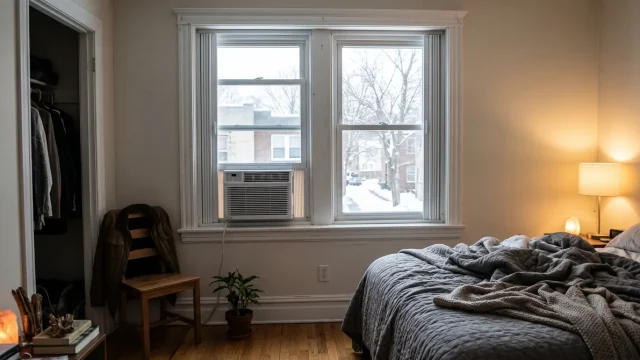
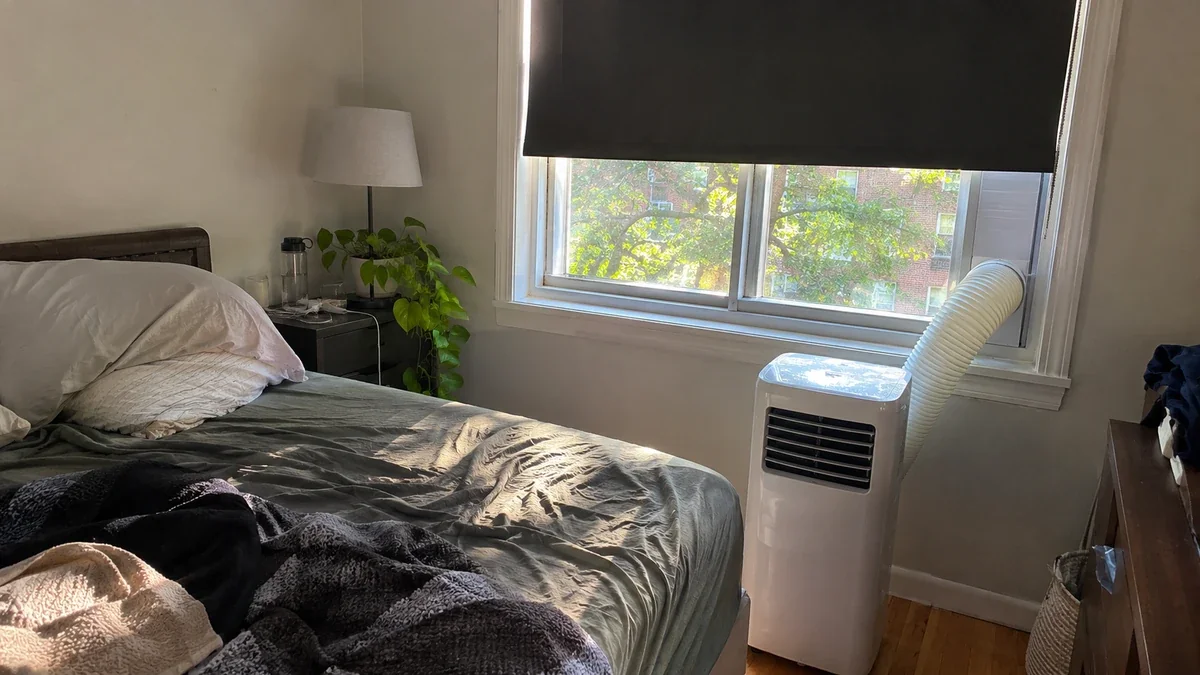
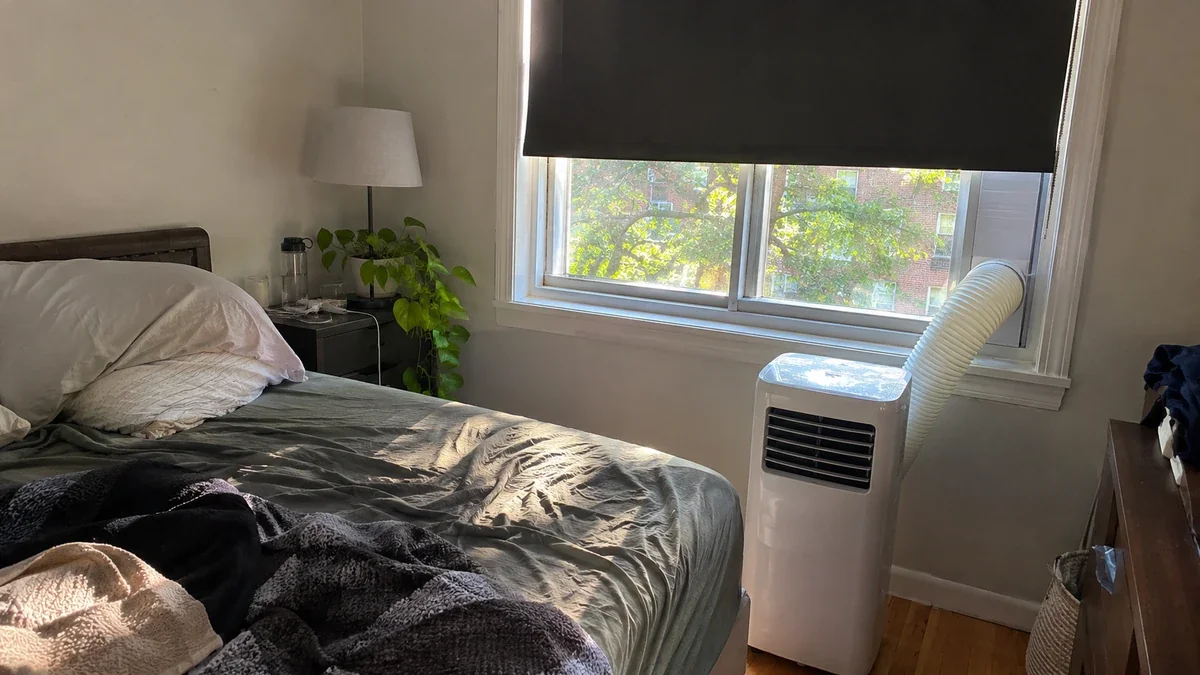
Portable cooling for renters works, but only if you match the machine to your climate and your room. A vented portable air conditioner is the one portable device that lowers room temperature in both humid and dry heat. Fans, shades and film make a room feel cooler or stop it heating up, but they do not remove heat.
Also read: Best No-Drill TV Wall Mounts for Renters (2026) · Mounting a TV on the Wall Without Drilling – 5 Renter Methods
The renter rule for everything below is simple: plug-in, no drilling, nothing screwed into the window frame, and it all goes with you at move-out. This guide covers the four real options, how to size one, how to vent it through a window with no tools, what it costs to run, and what to do when an old building is the real problem.
Quick answer
- Want real cooling in any climate? Buy a vented portable AC. A dual-hose model is more efficient than a single-hose one but costs more.
- Hot and dry summers? An evaporative cooler is far cheaper to buy and run, but it barely works in humid air.
- Just need to feel cooler? A tower or box fan plus blackout shades helps, but a fan never lowers the room temperature.
- Before any purchase, check the lease for the words “window-mounted appliances” and “wall penetrations.” A portable unit that sits in the window track rarely breaks either rule.
What Counts as Portable Cooling for Renters?
Not everything sold as portable cooling cools anything. Sort the options into three buckets before you spend money.
Machines that lower temperature. A portable air conditioner runs a refrigerant cycle, pulls heat out of the room and vents it outdoors through a hose. An evaporative cooler blows air across a wet pad, and the evaporation cools the air, but only when the air is dry.
Machines that move air. Tower, pedestal, box and ceiling fans do not cool the room. They cool you, by moving air over your skin so sweat evaporates faster. They use very little power, which is why they are the cheapest starting point.
Fixes that slow heat getting in. Blackout curtains, cellular shades, reflective window film and no-drill blinds do not produce cold. They stop the sun from heating the room in the first place. The U.S. Department of Energy says well-fitted cellular shades can cut unwanted solar heat gain noticeably, though results depend on the window and the product.
Most renters waste money by buying from the wrong bucket. A tower fan in a 95-degree flat with a west-facing window will not rescue you, and an evaporative cooler in humid Miami will make the room clammy.
Portable Cooling Options Compared
Ranges are typical, not tied to a sale, so confirm live prices (checked November 2026).
| Option | Lowers temperature? | Best for | Typical purchase price | Typical running cost per summer* |
|---|---|---|---|---|
| Portable AC, single-hose, ~10,000 BTU | Yes, any climate | Bedrooms and living rooms | $250 to $350 | About $100 |
| Portable AC, dual-hose inverter, ~12,000 BTU | Yes, faster and more efficient | Large rooms, all-summer use | $400 to $600 | About $110 |
| Evaporative cooler | Yes, dry climates only | Hot, dry air | $150 to $250 | About $8 |
| Tower fan | No, moves air over skin | Mild evenings, sleeping | $50 to $110 | About $4 |
| Box fan | No, useful for night flushing | Pushing hot air out at night | $20 to $40 | About $10 |
| Window AC (8,000 BTU) | Yes, strongest per dollar | Only where the lease allows it | $300 to $450 | About $80 |
*Running cost assumes 6 hours a day for 90 days at the U.S. average residential rate of 18.2 cents per kWh (U.S. Energy Information Administration, 2026). Your rate will differ.
Three notes on the table. First, a window AC is the best value per dollar of cooling, but it is not portable, blocks part of the window and many leases restrict it. See Can You Use a Window Air Conditioner Without a Window? for options when it will not fit. Second, the BTU on a portable AC box is a lab figure. The cooling you actually get under the DOE rating is lower, and for a single-hose unit it can be around half to two thirds of the headline number. Third, the evaporative cooler’s tiny running cost only counts where the air is dry.
How to Choose Portable Cooling for Your Rental
Choosing comes down to four questions: how big is the room, how humid is your climate, what kind of windows do you have, and what does the lease allow?
Size it by the room
Close the doors to rooms you will not cool, then measure the one you will. As a rough planning rule, cooling a typical room needs on the order of 20 BTU of real capacity per square foot. A 200 sq ft bedroom needs about 4,000 BTU of real cooling. Add roughly 10% for a south- or west-facing room with direct afternoon sun, and more for a top floor or single-pane windows. An undersized unit runs all day and never reaches the set temperature, and a badly oversized one wastes money and adds noise. Check the manufacturer’s room-size guidance for the exact model.
Match the machine to your climate
| Your summer | Best portable option | Why |
|---|---|---|
| Hot and humid (Gulf Coast, Florida, humid Northeast) | Portable AC | Only refrigeration works when humidity is high |
| Hot and dry (Southwest, high desert) | Evaporative cooler or portable AC | Evaporative cooling is cheap where air is dry |
| Mild with a few hot spells (Pacific Northwest, upper Midwest) | Tower fan plus blackout shades | A few hot weeks may not be worth a $300 AC |
| Hot days, cool nights | Box fan and night flush | Free cool air beats any machine |
| Top floor or sun-baked room, any climate | Portable AC plus blackout shades | Shades cut the heat load, the AC handles the rest |
Check the window before you buy
Every portable AC needs to vent hot air outside. Double-hung and sliding windows usually take the kit in the box. Casement and crank windows do not, and you may need a sliding-door kit or a cut-to-size clear acrylic panel held in place without screws. Sliding doors need a taller kit. Measure first.
Check the lease
Most leases say nothing about portable ACs because they change nothing about the property. Window-mounted units are different. Many leases ban them, require a bracket or require seasonal removal. Read for “window-mounted appliances,” “wall penetrations” and “exterior equipment,” and ask in writing if you are unsure.
Step by Step – Set Up Portable Cooling With No Drilling
Setting up a portable AC (about 30 minutes, no tools)
- Pick the spot. Place the unit within hose reach of the window. The shorter and straighter the hose, the better it cools. Leave clear space around the air intake and keep curtains away from it.
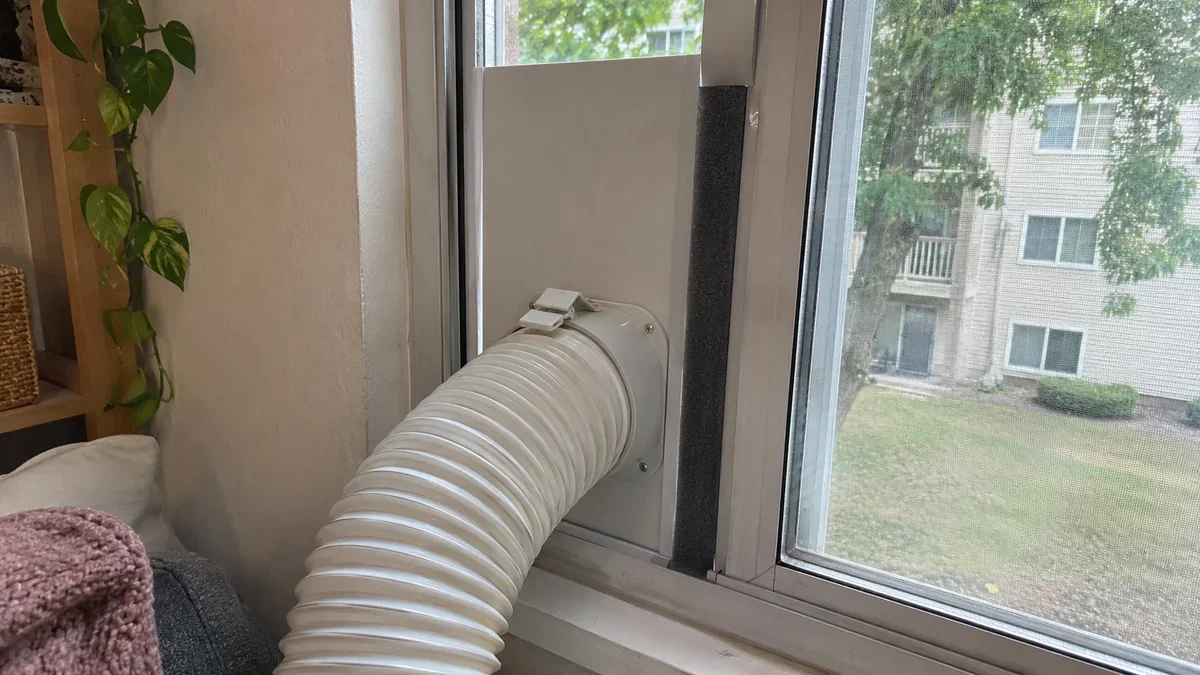
- Fit the window kit. The kit is a sliding panel that sits in the window track. Extend it to fill the opening and close the window on it. No screws, no brackets.
- Attach the exhaust hose. Connect it to the unit and clip the other end into the panel. Keep it short, since a long hot hose radiates heat back into the room.
- Seal the gaps. Press foam weatherstripping or removable window-seal tape into any gap around the panel. Hot air leaking back in is the most common reason a good unit disappoints.
- Handle the water. Portable ACs pull moisture from the air. Many models evaporate most of it out through the hose, but in humid weather the tank can fill. If your model has a continuous drain, run a small hose to a bucket or drain.
- Plug directly into the wall. A portable AC can draw around 1,000 watts or more. Use a grounded wall outlet on a circuit not shared with a microwave or space heater, and avoid long extension cords and cheap power strips.
- Close the room and wait. Shut the door, close blinds on sun-facing windows and give it 20 to 30 minutes. A portable AC cools one closed room well. It cannot cool an open-plan flat with every door open.
Venting through a sliding door or casement window
A sliding-door vent kit is a taller panel that fills the door track, typically $25 to $40. For a casement window, a cut-to-size acrylic panel can fill the opening, with the hose through a hole in the panel and weatherstripping around the edge. Both can come out in a minute at move-out.
Setting up an evaporative cooler (about 10 minutes)
Fill the tank with cold water and place the cooler near an open window or door. The cooler needs fresh dry air coming in and somewhere for humid air to go. In a sealed room it will raise the humidity until it stops helping.
The fan-and-shade routine (free, tonight)
Close blackout shades on sun-facing windows before the sun arrives, not after the room is hot. In the evening, once outside air is cooler than inside, put a box fan in one window facing out and crack a window on the opposite side. In the morning, shut everything again.
What Does Portable Cooling for Renters Cost?
These workings use the same assumptions as the table: 6 hours a day, 90 days, 540 hours a summer, 18.2 cents per kWh. Wattages are typical, so check your unit’s label.
| Machine | Typical watts | kWh per summer | Electricity per summer |
|---|---|---|---|
| Portable AC (single-hose) | about 1,000 | 540 | about $98 |
| Portable AC (dual-hose inverter) | about 1,100 | 594 | about $108 |
| Evaporative cooler | about 85 | 46 | about $8 |
| Tower fan | about 45 | 24 | about $4 |
| Box fan | about 100 | 54 | about $10 |
| Window AC (8,000 BTU) | about 800 | 432 | about $79 |
Three setups priced out
- Budget bedroom, any climate. A single-hose portable AC at around $300 plus about $98 of electricity is roughly $400 for the first summer, then about $98 each summer after, because the unit moves with you.
- Dry-climate setup. An evaporative cooler at around $200 plus about $8 of electricity is roughly $210 for the first summer. It costs about a twelfth as much to run as a portable AC, but only where the air is dry.
- Mild-summer setup. A tower fan, no-drill blackout blinds and reflective film at roughly $90 to $130 total plus about $4 of electricity gives no temperature drop but a real change in comfort. It is also the cheapest way to find out if you need an AC at all.
Purchase price dominates the first summer, and electricity dominates later ones. A portable AC at about $98 a summer costs close to $300 in power over three summers. If a dual-hose model is more efficient for your room, the higher price can pay back, but check the efficiency figures on the label. For a full cost view, see How Much Does It Cost to Run an Air Conditioner?.
Cooling for Renters in an Old Building
Some rentals resist every machine because the building is the problem: brick walk-ups, converted houses and top-floor flats with little insulation, single-pane windows and thick walls that soak up heat all day and release it at night. You cannot add insulation or replace windows, but you can attack three heat routes.
Through the glass. Sun through a window works like a heater you never switched on. You cannot add an exterior awning, but you can close blackout curtains or cellular shades before the sun hits and apply reflective window film to the worst windows. Fit film to clean glass with soapy water, and test a corner first, since some films can stress certain double-pane or coated glass. Read the film maker’s guidance.
Through the gaps. Old windows leak. Removable foam weatherstripping and a door draft stopper cost a few dollars and peel off at move-out.
From inside. Ovens, old halogen bulbs and busy computers dump heat into a small room. Cook late or use a microwave on hot days and switch to LEDs.
Size up. The room-size rule assumes average insulation. In an old building with single-pane windows, treat it as a minimum. Add roughly 10% for sun and another 10% for a top floor or poor insulation, and check what the manufacturer says for your room.
Best Cooling Solution for Renters – A Simple Ladder
If you want the best cooling solution for renters without overthinking it, climb this ladder and stop when the room is comfortable.
- Block the sun. Shades, film and a closed curtain before noon cost the least and cut the heat load for everything else.
- Move air. A fan helps you feel cooler and powers the night flush.
- Seal leaks. Removable foam strips keep cooled air in.
- Add a machine. Only now choose between a portable AC and an evaporative cooler, based on your humidity.
People often ask for the best cooler for renters as if one product wins everywhere. None does. A portable AC wins in humid places, an evaporative cooler wins in dry ones, and a fan with shades wins where summers are mild. The best cooler for renters is the one that fits your climate, your windows and your lease.
Cooling for Renters Old Building Checklist
For cooling for renters in an old building, run through this list before you spend anything:
- Do the windows leak air? Seal them with removable strips.
- Which windows face west or south? Cover those first.
- Is your wiring up to a 1,000-watt appliance? Ask the landlord if the breaker trips.
- Does the building trap heat on the top floor? Plan for a larger unit and a closed-door room.
- Is there a cooler room, such as a north-facing bedroom or basement? Sleep there on the worst nights.
Cool Home Projects for Renters – 5 No-Drill Upgrades That Help
“Cool home projects for renters” sounds contradictory, since most cooling projects need a drill. These five do not, and each takes under an hour.
- Reflective window film on the sunniest glass. Typical cost starts under $10 for a small roll. Best on west- and south-facing windows. Test it first.
- No-drill blackout blinds. Adhesive or tension-mounted shades that cut to size. See No-Drill Blackout Blinds for Renters.
- Door draft stopper and removable weatherstripping. Keeps warm hallway air out and cooled air in.
- A night-flush fan on a timer. A box fan in a window facing out, a cracked window opposite, and a smart plug so it runs 10 p.m. to 6 a.m. automatically. See Best Smart Plugs for Renters.
- A reflective panel for the window you never use. A foam board with reflective backing cut to fit a spare-room window blocks heat and lifts out in seconds.
None of these needs permission because none changes the property. Do them before you buy a machine. If the shades and film drop the room by a few degrees, a fan may be enough.
Landlord, Lease and Deposit – Before You Plug Anything In
- Portable ACs rarely need permission. They plug in, vent through a kit that sits in the track and leave no mark. Still, a short email costs nothing: “I plan to use a portable air conditioner in the bedroom. It plugs into a standard outlet and vents through a window kit that sits in the track, with no drilling or brackets.”
- Window units often need permission. Leases may require a bracket, limit them by floor or require winter removal.
- Mini-splits always need written consent. They need a hole through the wall, which is a modification.
- Photograph the window and sill before you install the kit and again after you remove it. Keep the original screen safe, since lost screens are a common small deduction.
- Check electrical limits. A portable AC on a circuit shared with a microwave or heater can trip the breaker. In an old building with weak wiring, ask the landlord before running a heavy appliance all night.
- Know your local rules. Some cities and countries require landlords to keep homes within a safe temperature range. Rules vary a lot by state, province and country, so check local tenant guidance and see Renter Rights When It’s Too Hot.
Mistakes to Avoid With Portable Cooling
- Buying by the headline BTU. The number on the box is a lab rating, and real cooling can be well below it.
- Skipping the seal. Gaps around the window kit let hot air back in.
- Using an evaporative cooler in humid weather. It will add moisture and little cooling.
- Running a long hose. Every extra foot adds heat.
- Using a power strip or long extension cord with a high-draw appliance.
- Cooling the whole flat with a unit sized for one room.
- Closing the shades late. Block the sun before it heats the room.
- Forgetting the drain, and finding the tank full at midnight.
Questions
Frequently asked questions.
What is the best portable cooling for renters?
For real cooling in any climate, a vented portable air conditioner. For hot, dry places, an evaporative cooler costs far less to run. For mild summers, a fan plus blackout shades may be enough.
Do portable air conditioners need a window?
Yes. A vented portable AC needs an exhaust hose to the outdoors, usually through a window kit in the track. A model that does not vent outside cannot lower the temperature of a room for long.
Is a portable AC allowed in a rental?
Usually yes, because it plugs in and leaves no mark. Check the lease for window-mounted appliances and ask in writing if unsure.
How do I cool a rental in an old building?
Block the sun with blackout shades and film, seal gaps with removable weatherstripping, size your unit up, and cut internal heat from ovens and old bulbs.
Does an evaporative cooler work in humid places?
Poorly. It needs dry air to cool, so it suits places like the desert Southwest and not the Gulf Coast.
How much does it cost to run a portable air conditioner?
A typical single-hose unit drawing about 1,000 watts costs around 18 cents per hour at 18.2 cents per kWh. Your cost depends on your rate and hours of use.
Conclusion – Your Next Step
Portable cooling for renters is a matching exercise. Pick the machine for your climate, size it for one room, seal the window kit and block the sun first. Start today with the free steps: close shades before the sun, set up the night flush and check the lease. If you want to know whether a window unit can work, read Can You Use a Window Air Conditioner Without a Window?, and for heat-pump options see window AC with heat pump or How Much Does It Cost to Heat a Rental?.
Sources: U.S. Department of Energy guidance on cellular shades and room air conditioners; ENERGY STAR guidance on portable air conditioners; U.S. Energy Information Administration average residential electricity price. Checked November 2026.