The HQST 200W ultra-light foldable portable solar panel is the best value pick for most renters: $159.99 on HQST’s site (checked November 2026), 11.82 lb, IP67, with a 3-in-1 cable that fits most power stations. If you want independent test results behind your choice, the Renogy E.Flex 200W is the safest all-rounder. If you own an Anker or EcoFlow station, read the voltage section before you buy, because some 200W panels run at 48 volts.
A 200 watt portable solar panel won’t run your apartment. On a sunny balcony, it can refill a portable power station that keeps a laptop, router, lamp or small fridge going, with no drilling and nothing for your landlord to sign. This guide compares six panels by the things that matter in a small rental: weight, folded size, unfolded length, connector, voltage and price per watt. Every spec comes from the maker’s page or a major retailer, plus independent test data and buyer reviews.
|
Quick answer: top 3 picks Best value: HQST 200W Ultra-Light Foldable, $159.99 ($0.80/W), 11.82 lb, IP67, 3-in-1 cable (XT60, DC7909, DC5521). Pre-order when checked. Best all-rounder: Renogy E.Flex 200W N-Type, $219.99, 13.89 lb, USB ports built in; measured 177 W in OutdoorGearLab’s 2026 test. Lightest premium: Anker SOLIX PS200 Bifacial, about $399.99, 10.6 lb, IP68. It’s a 48 V panel, so check your station’s input first. One rule for all: a panel stores nothing. Pair it with a power station whose solar input matches the panel’s voltage and plug. |
200W Portable Solar Panels Compared: Weight, Size and Price
The HQST is the cheapest per watt and among the lightest, the Anker Bifacial is the lightest outright, and Renogy has the strongest independent test result. The table puts the renter-relevant numbers side by side, with prices checked in November 2026.
| Panel | Price (Nov 2026) | $/W | Weight | Folded (in) | Opened length | Voltage class | Plug |
|---|---|---|---|---|---|---|---|
| HQST 200W Ultra-Light (HPP200N) | $159.99 | $0.80 | 11.82 lb | about 23.9 x 20.7 x 1.97 | about 71 in | 12 V class (Voc 20.7 V) | 3-in-1: XT60, DC7909, DC5521 |
| Renogy E.Flex 200W N-Type | $219.99 | $1.10 | 13.89 lb | 23.72 x 22.99 x 1.97 | about 88 in | 12 V class | MC4 + USB-C, USB-A |
| Bluetti SP200L | $349 to $399 | $1.75 to $2.00 | about 17.2 lb | about 23 x 24 x 1.7 | about 83 in | 12 V class (Voc 24.6 V) | MC4 |
| Anker SOLIX PS200 Bifacial | about $399.99 | $2.00 | 10.6 lb | 27.0 x 31.2 x 1.8 | 54.2 in (wide format) | 48 V (Voc 57.6 V) | MC4 + XT-60 cable |
| EcoFlow NextGen 220W Bifacial | $649 list, often discounted | $2.95 at list | about 15.9 lb | 23.6 x 22.5 x 1.3 | about 85 in | 12 V class | XT60 / MC4 |
| Jackery SolarSaga 200W | $699 list on Jackery.com | $3.50 at list | about 14 to 17.6 lb (varies by version) | about 23.6 x 23.5 x 1.6 | about 92 in | 12 V class | DC8020 + USB |
“Opened length” matters more than most guides admit. A typical rental balcony is 3 to 5 feet deep, and most four-fold 200W panels open to 7 feet or more. That’s why the HQST’s shorter strip and the Anker’s wide, two-fold shape are easier to fit. Approximate sizes come from manuals and retailer listings; confirm on the product page before ordering.
How We Chose (Based on Specs, Tests and Reviews)
We didn’t test these panels ourselves. Picks are based on manufacturer spec pages, current prices on brand and major retailer sites (checked November 2026), OutdoorGearLab’s July 2026 hands-on test of 200W panels, and buyer reviews.
We weighted four renter factors above raw efficiency claims:
-
Carry and store: weight and folded size, because you’ll haul it through a hallway and park it in a closet.
-
Balcony fit: opened length and stand angles.
-
Station match: voltage class and connector, so it actually charges what you own.
-
Value: price per watt and warranty length.
Efficiency claims of “up to 25%” are cell ratings and look similar across brands. Measured output varies far more. In OutdoorGearLab’s 2026 test, 200W-class panels measured anywhere from 112 to 182 watts over an hour in the same sun.
The 6 Best 200 Watt Portable Solar Panels for Renters
Each pick below covers what it does well in an apartment, how it stands up, and where it falls short. Prices are from November 2026 and move often, especially around Black Friday.
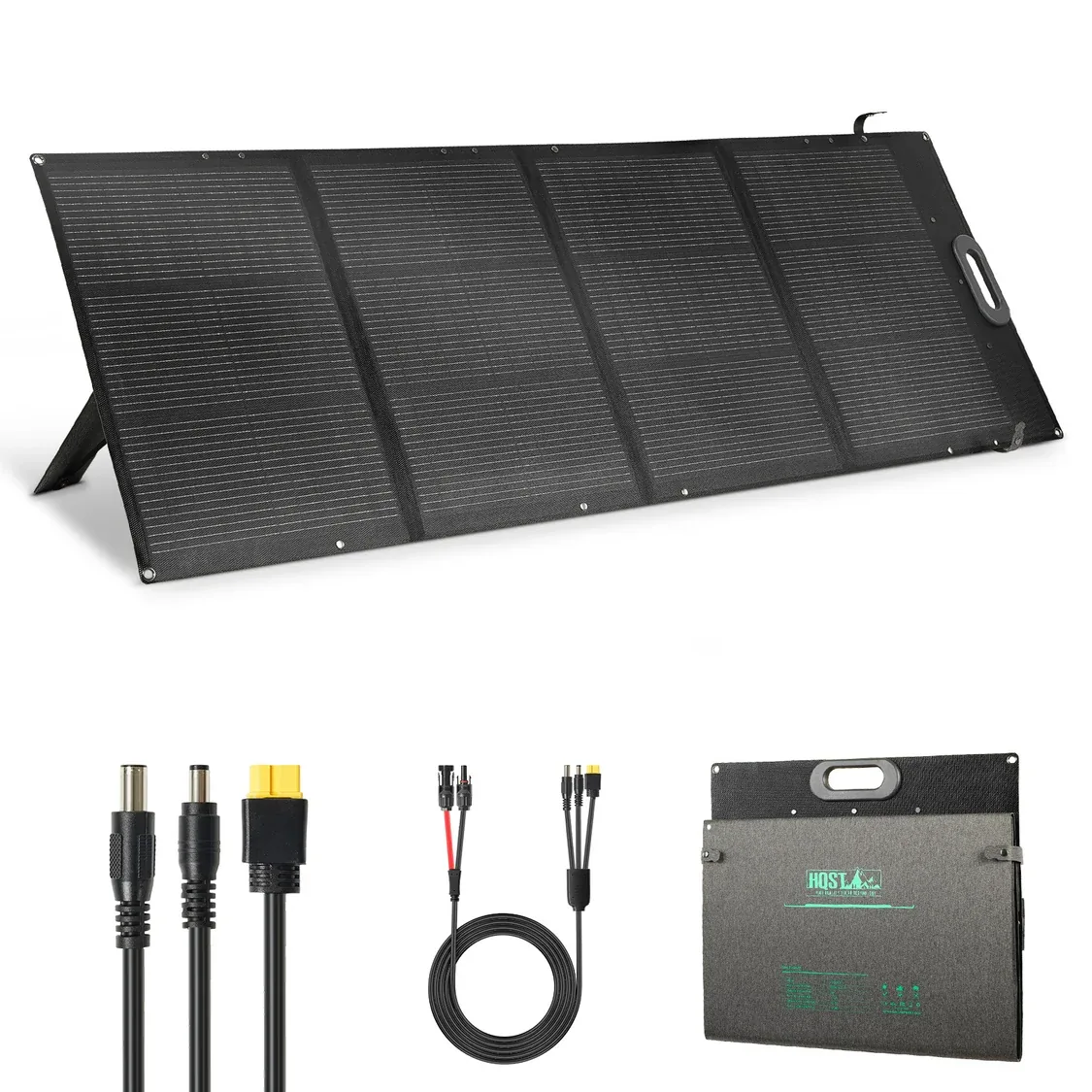
1. HQST 200W Ultra-Light Foldable Portable Solar Panel: Best Value
The HQST 200W ultra-light foldable portable solar panel wins on price and carry weight. HQST lists it at $159.99, down from $209.99, which works out to $0.80 per watt. It was on pre-order when checked, shipping in late November.
Renter fit: At 11.82 lb and under 2 inches thick folded, it’s the easiest full-size 200W panel here to carry up stairs and slide behind a couch. Its opened length of about 71 inches (per the manual) is noticeably shorter than the 82 to 92 inches of most rivals, so it’s more likely to fit a shallow balcony.
Mount type: Built-in kickstands with a 40 to 60 degree range. No railing hardware needed.
Specs: N-type cells up to 25% efficiency, IP67, Voc 20.7 V, 4.9 ft cable with XT60, DC7909 and DC5521 tips, one-year warranty.
Pros: lowest price per watt, light, short opened length, adapter tips for most stations.
Cons: short warranty, small review base on HQST’s site, and one buyer reported about 135 W in strong Florida sun. It wasn’t in OutdoorGearLab’s test, so there’s no independent output number yet.
2. Renogy E.Flex 200W N-Type: Best All-Rounder
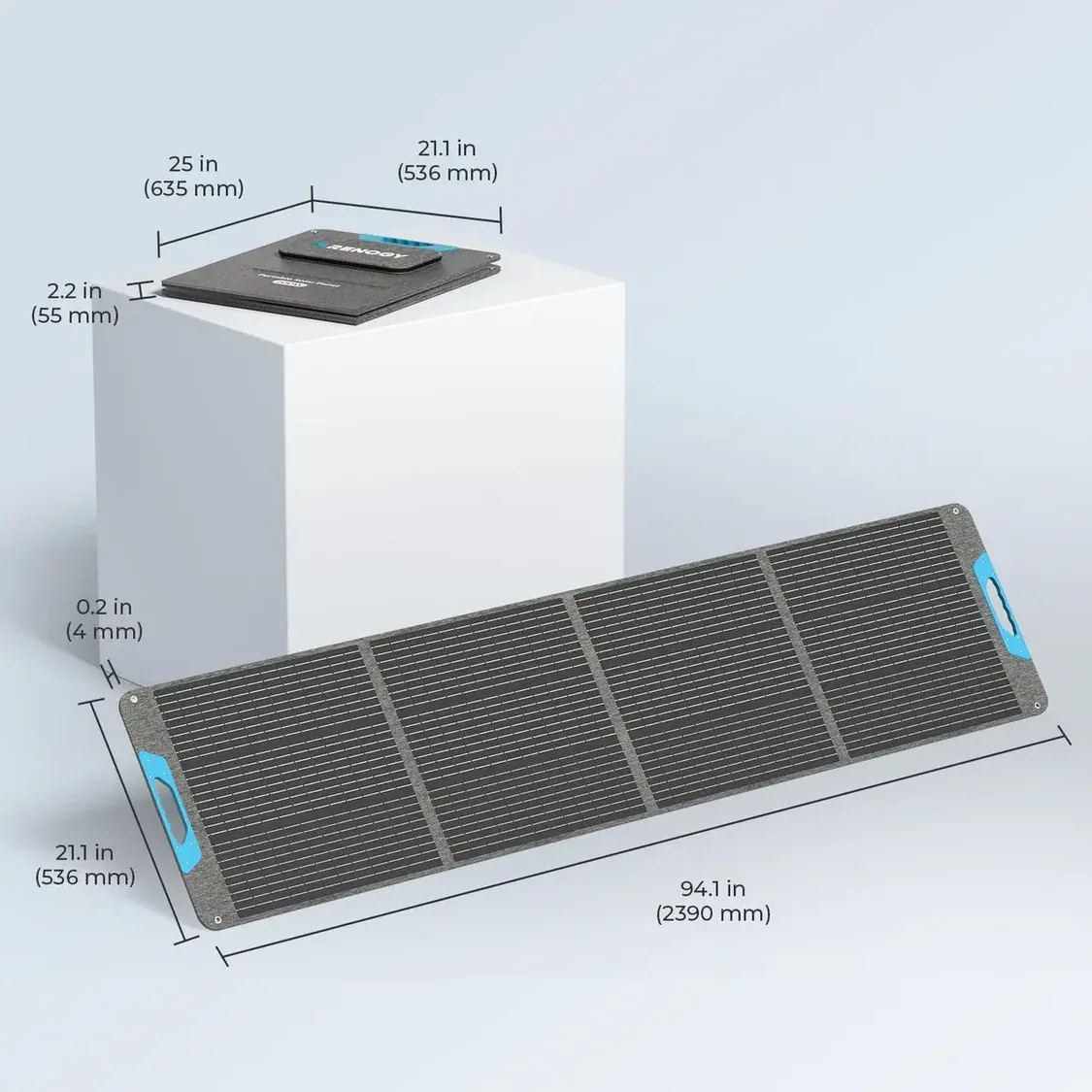
The Renogy E.Flex 200W is the safest pick if you want independent proof. OutdoorGearLab named it best for most people in July 2026 and measured 177 W in an hour against its 200 W rating.
Renter fit: 13.89 lb and 23.72 x 22.99 x 1.97 inches folded. It opens to roughly 88 inches, so measure your balcony. Built-in USB-C and USB-A ports let you charge a phone straight from the panel when you don’t need the station.
Mount type: Adjustable kickstands plus mounting holes you can tie down on windy floors.
Specs: 25% N-type cells, IP65, MC4 output, $219.99 on Renogy’s site (checked November 2026).
Pros: strong measured output, good price, direct USB charging.
Cons: IP65 is a step below IP67/IP68, so bring it in during heavy rain, and you may need an MC4 adapter for your station.
3. Bluetti 200W Solar Portable Solar Panel (SP200L): Best for Bluetti Owners
The Bluetti 200W solar portable solar panel sold now is the SP200L, a standard 12 V-class panel with MC4 plugs. Bluetti’s US store showed $349 to $399 in November 2026, depending on the listing.
Renter fit: It folds to a near-square shape about 23 x 24 inches that stores flat under a bed, but at about 17 lb it’s one of the heavier panels here and opens to about 83 inches.
Specs: up to 23.4% efficiency, Voc about 24.6 V, MC4, 12-month warranty. OutdoorGearLab measured 150 W from the Bluetti 200W it tested.
Pros: plain MC4 works with almost any station, flat storage.
Cons: heavier, lower measured output than Renogy or Jackery, short warranty. Older PV200 and PV200D versions are still listed by resellers, so match the model number.
4. Anker SOLIX PS200 Bifacial: Lightest Premium Pick
The current Anker SOLIX PS200 Bifacial weighs 10.6 lb, the lightest panel here, and folds into a wide 27.0 x 31.2 x 1.8 inch slab. It runs around $399.99 at major solar retailers.
Renter fit: Its two-fold design opens to just 54.2 inches long but 31.2 inches wide, which suits a shallow balcony. The back side can pick up light reflected off a pale floor or wall.
Specs: IP68, output 48 V at 4.16 A, MC4 plus an XT-60 cable, five-year warranty listed by sellers.
Pros: lightest, short and wide shape, best weather rating, long warranty.
Cons: 48 V output only works with stations that accept higher solar voltages (see the next section). The older PS200 is a different panel at about 20 lb, so check the model.
5. EcoFlow NextGen 220W Bifacial: Best for EcoFlow Owners
EcoFlow’s NextGen panel is rated 220 W, a little more headroom than a 200W panel, with an XT60 connection that plugs straight into EcoFlow stations. It lists at $649 and is often discounted at retailers.
Specs: 25% TOPCon cells, IP68, built-in 30 to 60 degree stand, about 15.9 lb, folded 23.6 x 22.5 x 1.3 inches. Sellers list weights from 5.1 to 7.2 kg depending on version, so confirm before you buy.
Pros: highest measured output among folding panels in OutdoorGearLab’s test, sturdy integrated stand.
Cons: expensive at list, heavier than HQST or Anker.
6. Jackery SolarSaga 200W: Best for Jackery Owners
The Jackery SolarSaga 200W is listed at $699 on Jackery’s site with a 3-year plus 2-year warranty when bought direct. It uses Jackery’s DC8020 plug and adds USB ports.
Specs: IP68, bifacial. OutdoorGearLab measured 171 W and weighed its sample at 14.2 lb, while Jackery’s current spec sheet lists 8.0 kg (about 17.6 lb). The difference is a version change, so check which one you’re getting.
Pros: long warranty, good measured output, direct USB charging.
Cons: highest price per watt here at list, proprietary plug for non-Jackery stations. Wait for a sale.
Anker PS200 Portable Solar Panel 200W 2 Pack and 4 Pack: Check Voltage First
An Anker PS200 2 pack or 4 pack only makes sense if your power station’s solar input can take the PS200’s voltage. Each PS200 outputs about 48 V with a 57.6 V open-circuit voltage, roughly double a typical 12 V-class panel.
Anker’s own FAQ says the PS200 charges power stations with a maximum input of up to 60 V. Here’s what that means for multi-packs:
| Setup | Total watts | Wiring | Open-circuit voltage | What your station needs |
|---|---|---|---|---|
| 1 x PS200 | 200 W | Single panel | 57.6 V | Solar input that accepts at least 60 V |
| Anker PS200 2 pack | 400 W | Parallel (Y-branch) | 57.6 V, current doubles | 60 V+ input rated for the higher current and 400 W |
| Anker PS200 2 pack | 400 W | Series | 115.2 V | Input rated above 115 V; too high for 60 V stations |
| Anker PS200 4 pack | 800 W | Two parallel pairs on two inputs, or as the manual allows | Depends on wiring | Large dual-input station rated for 800 W of solar |
For most renters, an Anker PS200 portable solar panel 200W 4 pack is too much. Four panels need about 18 feet of open length and a big station to use 800 W. One or two panels is the realistic balcony ceiling. Treat 2 pack and 4 pack listings as bundles, and compare them against the single-panel price times two or four.
Will a 200 Watt Portable Solar Panel Fit My Power Station?
A portable 200 watt solar panel will fit if the panel’s open-circuit voltage is inside your station’s solar input range and you have the right plug. Check both in the station’s manual before you order.
Match These Three Numbers
-
Voltage: the panel’s Voc must be below your station’s maximum solar input voltage. HQST, Renogy, Bluetti, EcoFlow and Jackery panels sit around 20 to 25 V. The Anker PS200 sits at 57.6 V.
-
Wattage: your station’s solar input should be at least 200 W, or it will cap the panel.
-
Plug: XT60, DC7909 (8 mm), DC8020, Anderson or MC4. An adapter cable costs a few dollars; a mismatch costs a weekend.
How Much Power Will a Portable 200W Solar Panel Make on a Balcony?
Plan on about 120 to 180 watts at midday in good sun, less with shade or heat. In OutdoorGearLab’s test, Renogy measured 177 W, Jackery 171 W, Anker’s PS200 166 W and Bluetti 150 W, while the weakest panel made 112 W.
A cautious daily estimate: 150 W average over about 4 good sun hours is roughly 600 Wh. That’s enough to refill a 500 Wh station or run a Wi-Fi router (about 10 W) for more than two days.
100W vs 200W vs 400W: Is a Portable 200 Watt Solar Panel the Right Size?
For most apartment balconies, yes. A 200W panel is the biggest size most people can carry, store and fit on a balcony without a second trip, and it makes enough power to refill a small or mid-size power station in a sunny day.
| Size | Typical weight | Opened length | Best for | Watch out for |
|---|---|---|---|---|
| 100W | about 5 to 9 lb | about 3 to 4 ft | Phones, a laptop, a 300 Wh station | Slow on cloudy days |
| 200W | about 11 to 18 lb | about 4.5 to 7.5 ft | 500 to 1,000 Wh stations, router and fridge backup | Needs a clear strip of balcony |
| 400W | about 20 to 35 lb | 8 ft or more | Large stations, patios and yards | Too long for most balconies; heavy to carry daily |
Picture a renter on the fourth floor with a 4 x 8 foot balcony and a 1,000 Wh power station. A 100W panel would take two good days to refill it. A 400W blanket won’t open flat in that space. A 200 watt solar panel portable enough to carry in one hand, like the HQST or Anker, fills the station in roughly a day of good sun and folds away behind the couch at night.
What Can Portable 200W Solar Panels Actually Run?
A panel feeds the station, and the station runs your devices. Using the cautious 600 Wh-a-day estimate above, here’s roughly what a day of sun covers:
| Device | Typical draw | Hours from about 600 Wh |
|---|---|---|
| Wi-Fi router | 10 W | about 50+ hours |
| Laptop | 50 W | about 10 to 11 hours |
| LED lamp | 10 W | about 50+ hours |
| Mini fridge (cycling) | about 40 to 60 W average | about 10 to 14 hours |
| Box fan | 50 W | about 10 to 11 hours |
Device draws are typical ranges; check the label on yours. Station losses of 10 to 15% are already a reason to round down.
Buying Checklist for Portable Solar Panels 200W
Run through this before you buy portable 200W solar panels from any brand. It takes five minutes and saves a return.
-
Measure your balcony depth and width, and compare with the panel’s opened length.
-
Check your station’s solar input voltage range, wattage limit and plug type.
-
Weigh the stairs factor: under 14 lb is easy for most people to carry daily.
-
Prefer IP67 or IP68 if the panel stays out for hours; IP65 means bring it in when it rains.
-
Compare warranties: one year (HQST, Bluetti) versus five years (Anker, Jackery).
-
Confirm stock and shipping date; several panels were on pre-order or backorder in November 2026.
-
Check your lease for balcony rules about items on or over the railing.
How to Set Up and Remove a Portable 200W Solar Panel in a Rental
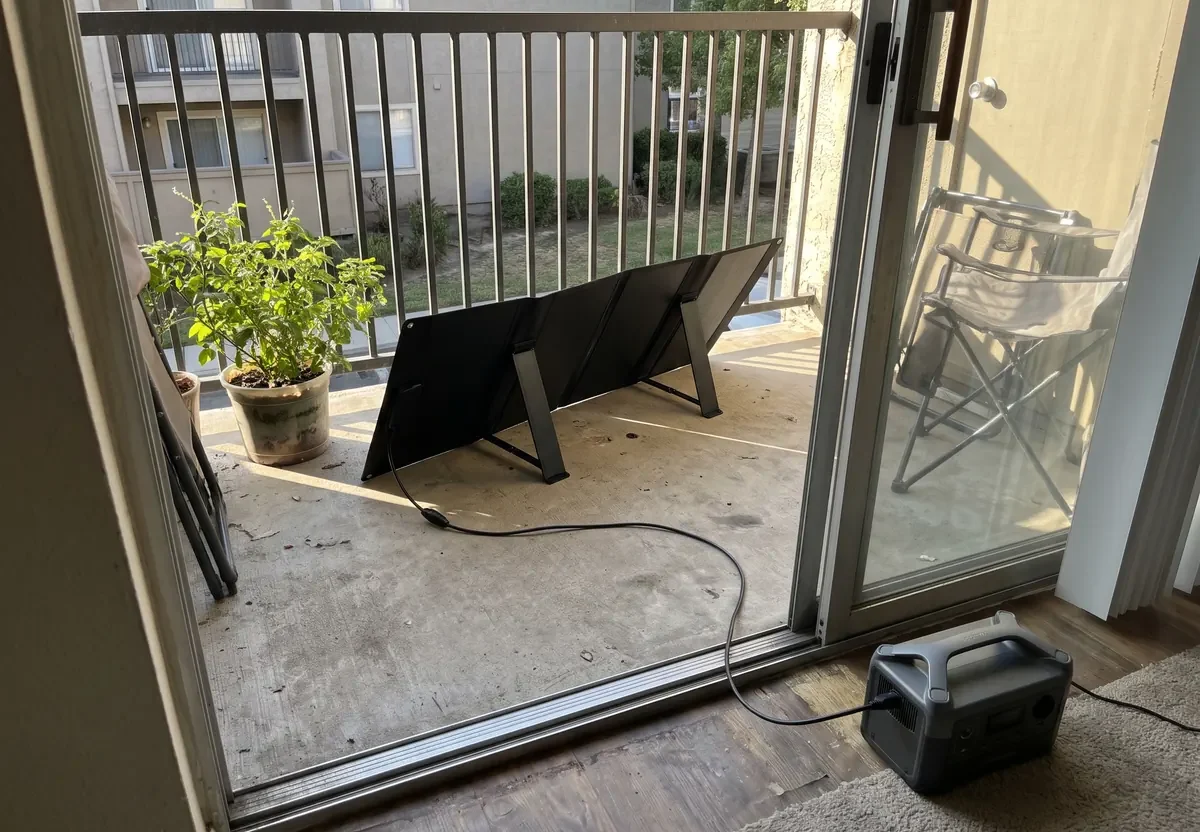
Setup takes about five minutes and needs no tools or drilling. Removal is just folding it up, which is the whole point for renters.
-
Pick the sunniest spot inside the balcony line, ideally facing south. Avoid railing shadows across the cells, since shading one strip cuts output a lot.
-
Unfold the panel on its kickstands. Angle it steeper in winter and flatter in summer.
-
Keep it outside. Window glass cuts output noticeably, so a panel behind a closed window charges far slower.
-
Run the cable through the door gap to the power station indoors, and keep it flat so nobody trips.
-
Tie the stand down or weigh it down on windy floors. A panel is a sail; never lean it on or over the railing.
-
Fold it and bring it in before storms and when you’re away. That’s also your move-out removal: nothing to patch.
Plugging a panel into a wall outlet is a different, regulated setup; for that, see What States Allow Plug-In Solar? (State-by-State Tracker).
Frequently Asked Questions
What is the best 200 watt portable solar panel for an apartment?
For most renters, the HQST 200W ultra-light foldable is the best value at $159.99 and 11.82 lb. The Renogy E.Flex 200W is the safest all-rounder, with 177 W measured in an independent test.
How much does the HQST 200W ultra-light foldable portable solar panel weigh?
HQST lists it at 11.82 lb, and it folds to 1.97 inches thick. That’s about 5 lb lighter than many 200W suitcase-style folding panels.
Can I use an Anker PS200 with a non-Anker power station?
Yes, if the station’s solar input accepts the PS200’s 57.6 V open-circuit voltage and you have an MC4 or XT60 connection. Many smaller stations top out lower, so check the manual first.
Can a 200W portable solar panel charge through a window?
It works, but glass cuts the output noticeably. For real charging, put the panel outside on the balcony or patio in direct sun.
Do I need my landlord’s permission for a portable solar panel?
Usually not for a panel that sits on its own stand on your balcony and charges a power station, since nothing is attached or wired in. Check your lease for balcony rules, and get permission before attaching anything to the railing.
Bottom Line: Is the HQST 200W Ultra-Light Foldable Portable Solar Panel Worth It?
For most renters, the HQST 200W ultra-light foldable portable solar panel is the smart buy: the lowest price per watt we found, light enough to carry daily, and short enough for a small balcony. Choose the Renogy E.Flex if you want proven output and USB ports, or the Anker PS200 Bifacial if weight matters most and your station takes 48 V.
Your next step: measure your balcony, check your power station’s solar input, then pick the panel that matches both. For the bigger picture, start with Solar Panels for Apartments & Renters: Complete Guide
Prices and specs checked November 2026. Prices change often; confirm on the seller’s page before buying.
Sources (external links for the article)
-
HQST product page (HPP200N-G1-US): hqsolarpower.com/products/hqst-ultra-light-200w-foldable-portable-solar-panel
-
Renogy E.Flex 200W N-Type: renogy.com/products/renogy-e-flex-200w-portable-solar-panel
-
Anker SOLIX PS200 (original) specs and FAQ: us.anker.com/products/a24321a1
-
Anker SOLIX PS200 Bifacial specs: ankersolix.com
-
BLUETTI SP200L: bluettipower.com
-
EcoFlow NextGen 220W Bifacial: ecoflow.com
-
Jackery SolarSaga 200W: jackery.com/products/solarsaga-200w-solar-panel
-
OutdoorGearLab, Best Portable Solar Panels (updated July 13, 2026): outdoorgearlab.com