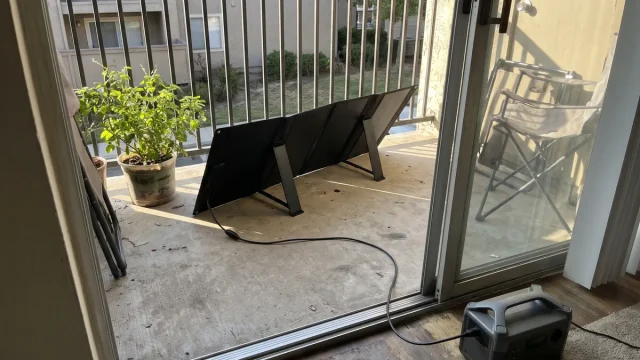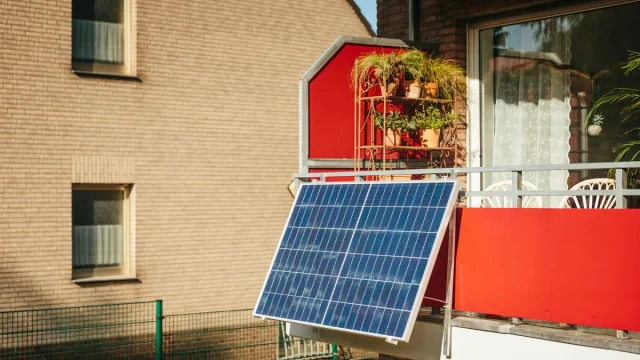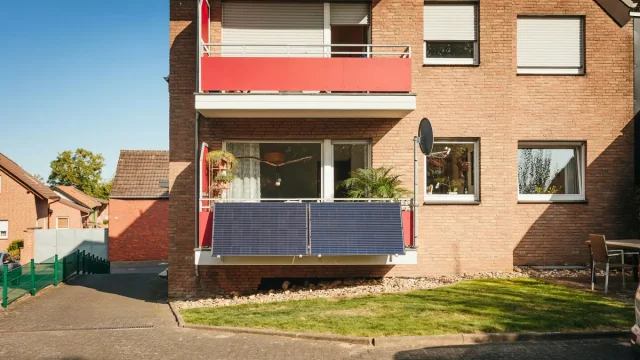
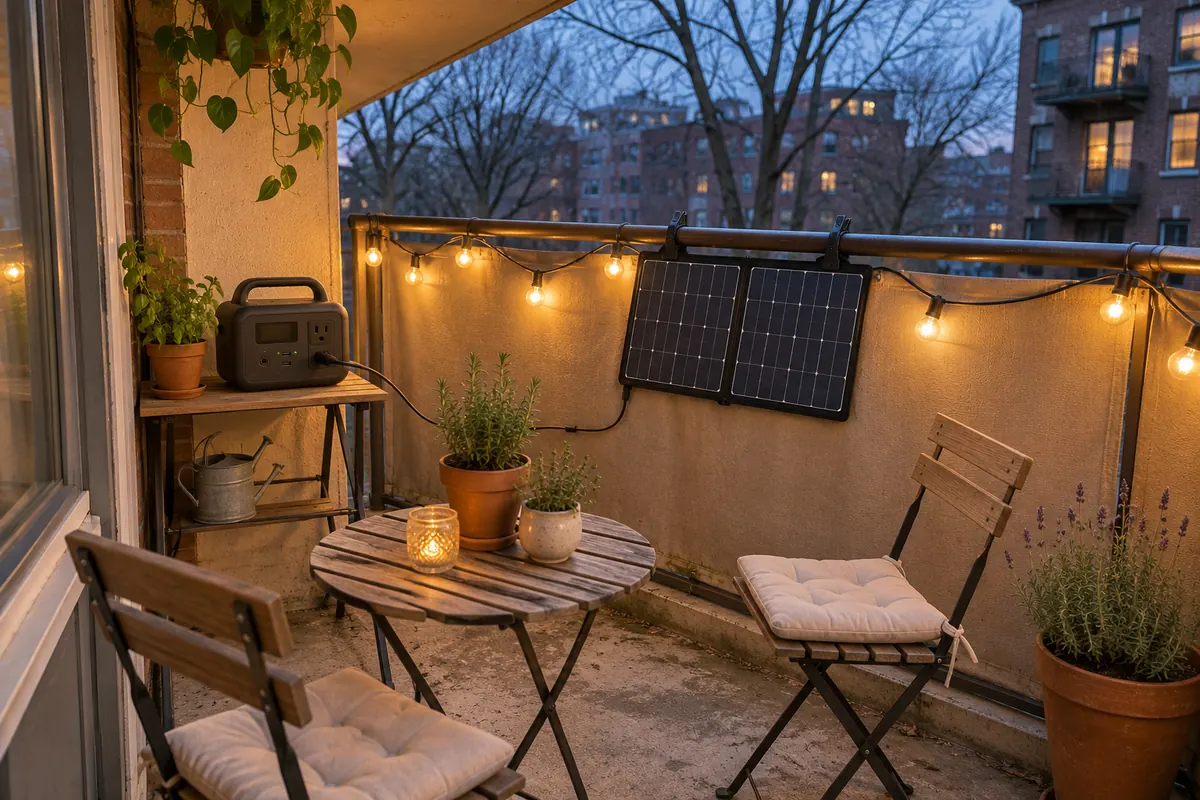
A solar powered outdoor outlet for a renter is almost always a portable power station: a battery with regular AC outlets that you recharge from a small solar panel on the railing. For a typical balcony, a 286 to 504Wh unit like the EcoFlow RIVER 3 Plus or BLUETTI AC60P runs string lights, a speaker and a laptop for hours. It won’t run a space heater, a grill or anything else that pulls close to 1,500 watts.
Here’s the scene most of us are working with: a small balcony, a string of patio lights, no outdoor outlet, and a lease that says no extension cords out the door. This guide compares the real options by what they can power, how long they last, and whether they can actually sit outside in the rain.
Quick answer: top 3 picks
- Best for most balconies: EcoFlow RIVER 3 Plus. 286Wh, 600W, three AC outlets, up to 220W solar input. List price $299 (checked November 2026).
- Best if it’ll sit outside: BLUETTI AC60P. 504Wh, 600W, IP65 water and dust resistance. List price $699.
- Best lightweight pick: Jackery Explorer 300 Plus. 288Wh, 300W, about 8.3 lb. Around $200 to $300 depending on retailer.
- Lights only? Solar string lights with a built-in battery and USB backup are cheaper than any power station.
Table of contents
- Solar powered outdoor outlet picks compared
- How we chose
- What is a solar powered outlet outdoor setup, really?
- The 6 best solar powered outdoor outlets for renters
- What can a solar power electrical outlet actually run?
- Solar powered outdoor electrical outlet buying checklist
- Setup on a balcony, and packing it away
- Mistakes to avoid
- FAQ
- The bottom line
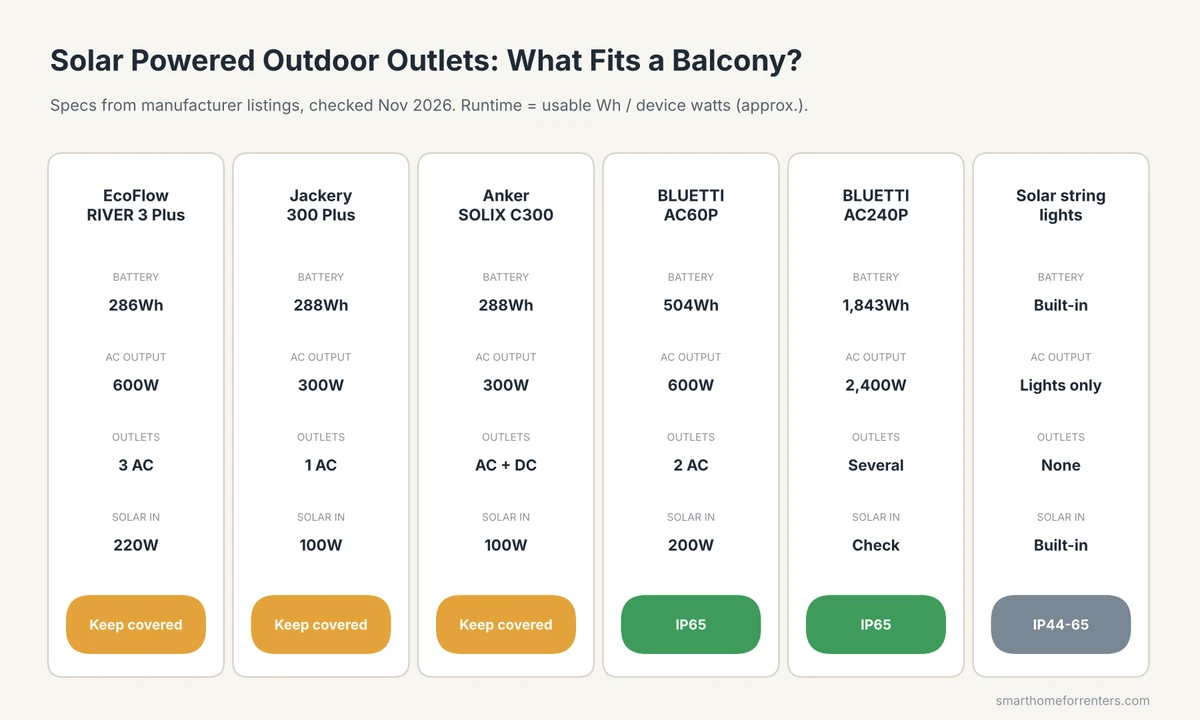
Solar powered outdoor outlet picks compared
The best pick depends on two things: how many watts your devices pull, and whether the unit will be exposed to weather. Here’s how the main options line up.
| Pick | Battery | AC output (surge) | AC outlets | Max solar input | Weather rating | Weight | List price (checked Nov 2026) |
|---|---|---|---|---|---|---|---|
| EcoFlow RIVER 3 Plus | 286Wh LiFePO4 | 600W (1,200W X-Boost) | 3 | 220W | Not rated for rain | 10.4 lb | $299 |
| Jackery Explorer 300 Plus | 288Wh LiFePO4 | 300W (600W) | 1 (US spec) | 100W | Not rated for rain | 8.27 lb | ~$200-$300 |
| Anker SOLIX C300 (AC version) | 288Wh LFP | 300W (600W SurgePad) | AC + DC | 100W | Not rated for rain | Check listing | ~$159-$215 |
| BLUETTI AC60P | 504Wh LiFePO4 | 600W | 2 | 200W | IP65 | 21.2 lb | $699 |
| BLUETTI AC240P | 1,843Wh LiFePO4 | 2,400W (3,600W lifting) | Several | Check listing | IP65 | Heavy (patio unit) | Check listing |
| Solar string lights with battery | Small built-in pack | No AC outlet | None | Built-in panel | IP44-IP65 typical | Light | ~$30-$100 |
Prices move often with sales, so treat them as list prices on the date checked. “Not rated for rain” means we found no water-resistance rating in the maker’s specs.
How we chose
We picked these based on manufacturer spec sheets, user manuals and buyer reviews from retailers including Best Buy, REI, Lowe’s and Home Depot. We didn’t run our own load tests, so the runtimes in this guide are estimates you can check against the math shown later.
Each option was judged on what matters on a rental balcony:
- Usable output: continuous watts and surge.
- Battery size in watt-hours.
- Solar input limit and whether a balcony-size panel can realistically refill it.
- Weather rating, since most balconies aren’t fully covered.
- Weight and size, because you’ll carry it inside often.
We compared five brands and two product types, with no paid placements.
What is a solar powered outlet outdoor setup, really?
A solar powered outlet outdoor setup is a battery with an inverter and household-style sockets, charged by a solar panel. There’s no permanent wiring, so it’s the only kind of “outdoor outlet” most renters can add.
The term gets used for three different things, and mixing them up leads to bad buys:
- Portable power station plus panel. The battery stores power, the inverter makes 120V AC, and the panel refills the battery. This is what most people mean, and it’s what this guide ranks.
- Low-voltage solar lighting kits. Some cheap “solar outlet” stakes only put out low-voltage DC through a special connector. Your regular plug-in patio lights won’t work with them.
- Grid-tied balcony solar. Plug-in solar kits that feed power back into your apartment’s circuits are a different product with different rules.
Renogy makes a useful distinction on its own blog: a basic solar outlet without a real battery only works while the sun is shining. For evening lights, you need storage, which means a power station.
For the bigger picture on renting and solar, start with Solar Panels for Apartments & Renters: Complete Guide.
The 6 best solar powered outdoor outlets for renters
Each pick below lists who it suits, the key specs, and the trade-offs buyers mention most.
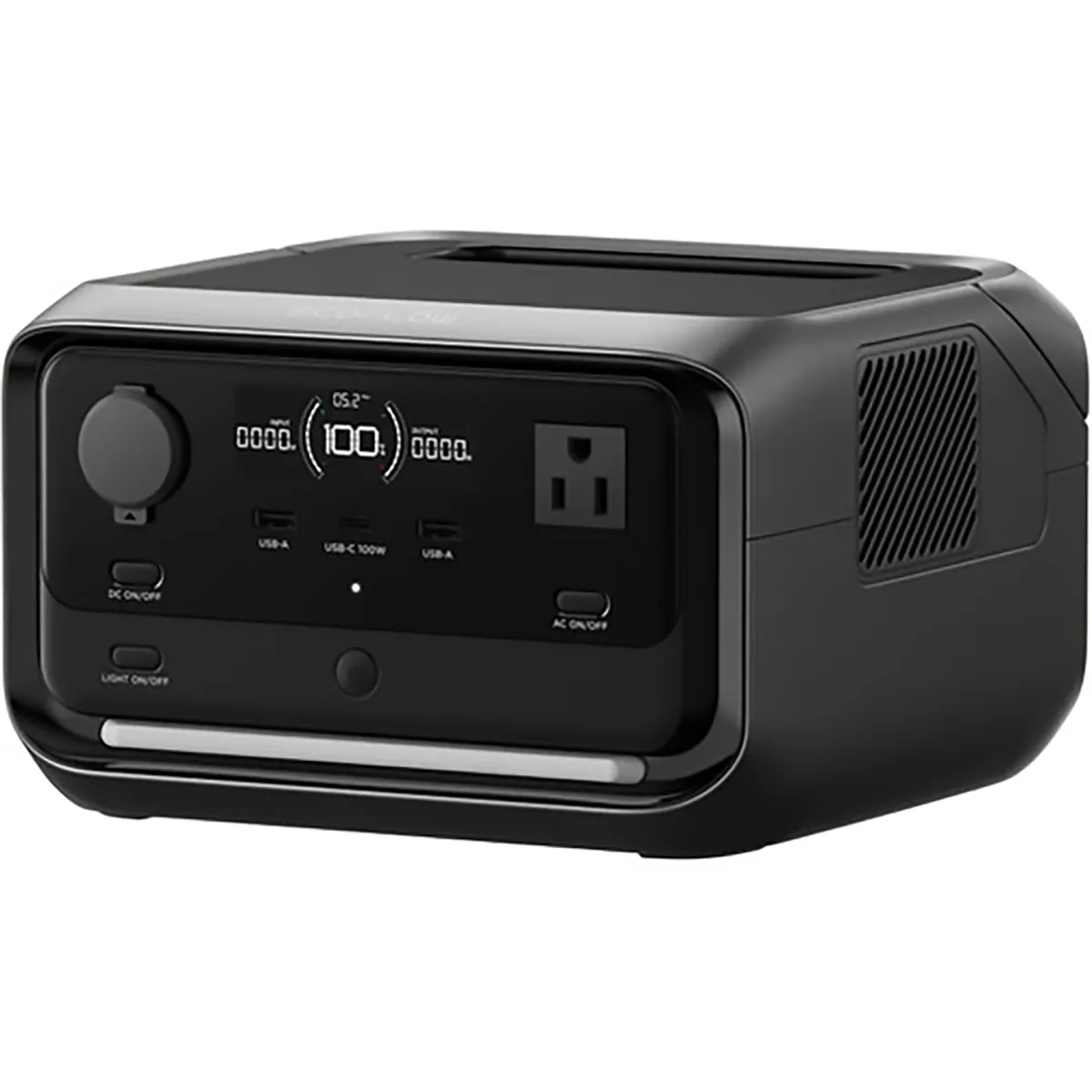
1. Best for most balconies: EcoFlow RIVER 3 Plus
Renter fit: a typical balcony or small patio with lights, a speaker, phones and a laptop.
The RIVER 3 Plus has a 286Wh LiFePO4 battery, three AC outlets rated for 600W total, and X-Boost up to 1,200W for some resistive loads. It accepts up to 220W of solar input and weighs 10.4 lb. EcoFlow’s list price is $299 (checked November 2026), and you’ll often see it lower on sale. Retail listings also mention optional extra batteries that stack on the unit to reach 858Wh.
One detail renters in cold climates should know: published specs list a charging temperature range of 32°F to 113°F. Winter balcony charging below freezing won’t work.
Pros
- Three AC outlets at this size is rare.
- 220W solar input refills faster than most small units.
- Expandable later.
Cons
- No water-resistance rating, so keep it covered.
- 286Wh goes fast with anything over 100W.
- X-Boost isn’t the same as running a high-watt appliance properly.
2. Best lightweight pick: Jackery Explorer 300 Plus
Renter fit: you carry it in and out every day, or you also want it for camping.
The Explorer 300 Plus packs a 288Wh LiFePO4 battery and a 300W inverter (600W surge) into about 8.27 lb. Its solar input tops out at 100W. Jackery’s US spec lists one AC outlet (a few retail listings say two, so check), plus USB-C, USB-A and a car port. REI lists it at $300, and authorized dealers have sold it for around $200 to $220 (checked November 2026). If you’re using another brand’s panel, you’ll need an adapter cable with Jackery’s DC8020 connector.
Pros: very light, LiFePO4 battery, fast USB-C. Cons: one AC outlet, 100W solar input means slow solar refills, no water rating.
3. Best budget pick: Anker SOLIX C300
Renter fit: mostly USB devices (phones, tablets, a USB speaker) with a small AC load.
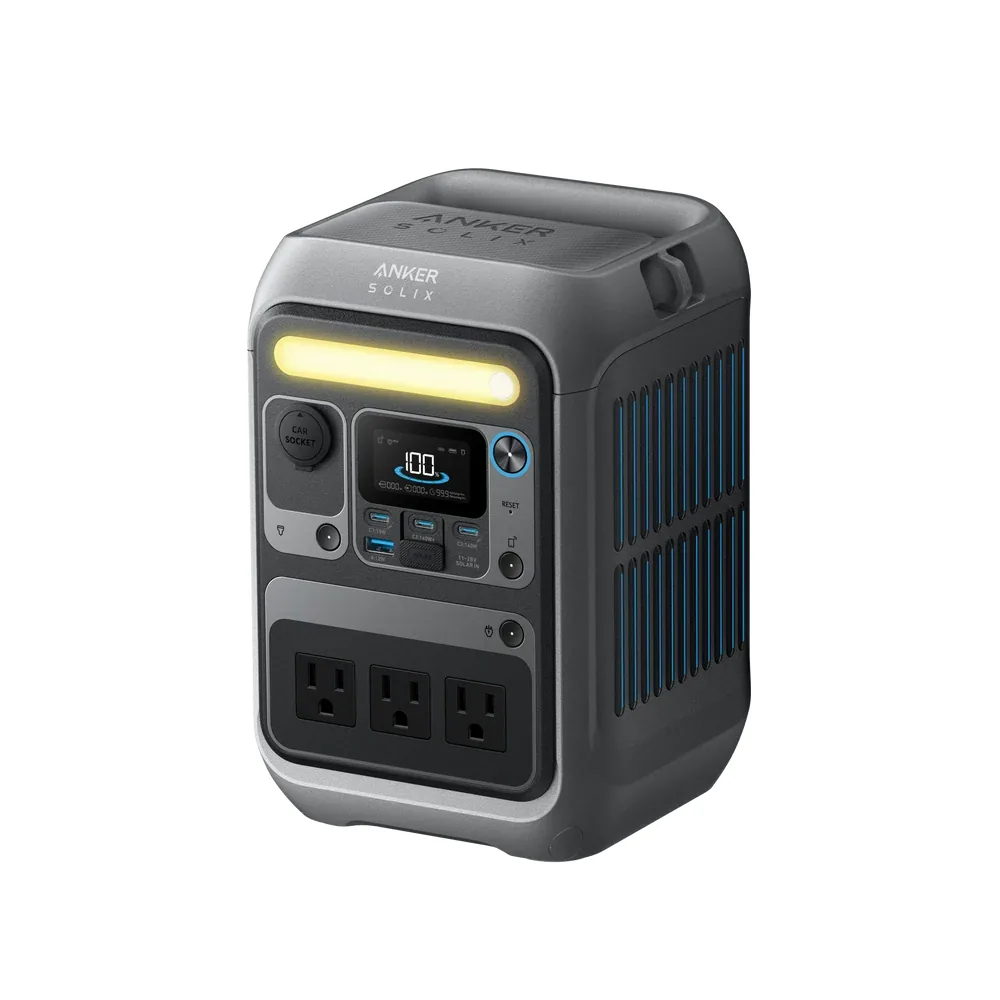
The C300 has a 288Wh LFP battery, 300W of AC output (600W with SurgePad) and two 140W USB-C ports that work both ways. Solar input is up to 100W, and Anker says to use 11 to 28V panels with an XT60 connector. Price trackers have shown it from about $159 to $215 at major retailers.
Watch the model name. Anker sells a C300 DC that has the same 288Wh battery but no AC outlet, so it can’t run a regular plug. If you want an outlet, buy the plain C300.
Pros: low price, great USB-C ports, quiet. Cons: easy to buy the DC-only version by mistake, modest AC power, no water rating.
4. Best if it has to sit outside: BLUETTI AC60P
Renter fit: uncovered balconies, poolside patios, or anyone who forgets to bring things in.
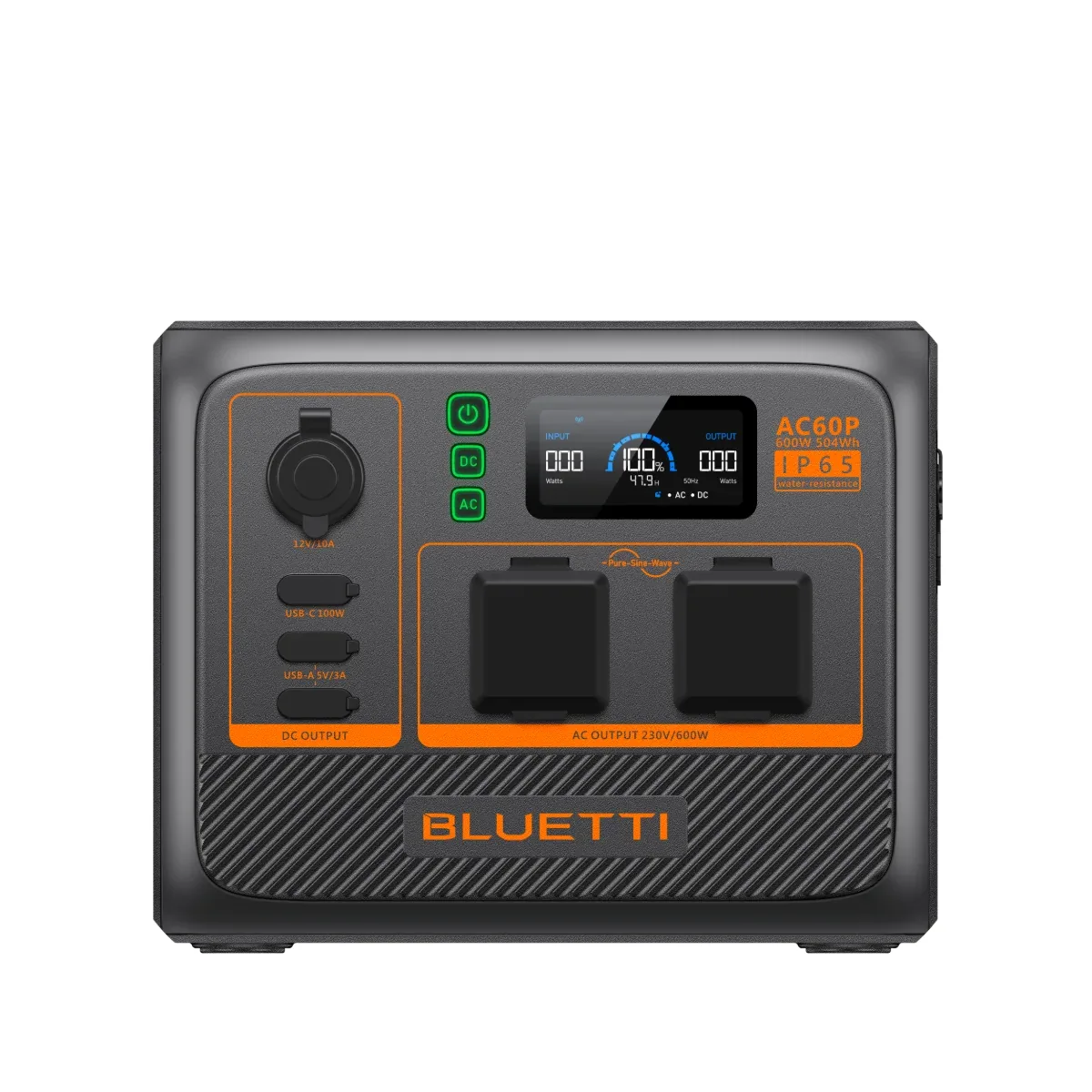
This is the pick that fixes the biggest problem most guides skip. The AC60P has an IP65 rating, which BLUETTI says protects against dust and low-pressure water jets from any direction. It carries a 504Wh LiFePO4 battery, two 120V AC outlets with 600W total, up to 200W of solar input, and a 6-year warranty. It weighs 21.2 lb and lists at $699 on BLUETTI’s US store (checked November 2026).
Be clear on what IP65 means, though. BLUETTI’s own FAQ for the AC60 says the unit isn’t waterproof. IP65 covers splashes and rain, not puddles or submersion.
Pros: real weather rating, bigger battery, long warranty. Cons: heavier and pricier than compact picks, solar input limited to 200W.
5. Best for big patios: BLUETTI AC240P
Renter fit: ground-floor patios or yards where you want to run a projector, a blender or a mini-fridge.
The AC240 line is BLUETTI’s larger IP65 series. The original AC240 (1,536Wh, 2,400W) is now listed as discontinued on BLUETTI’s US store, and the current AC240P bumps the battery to 1,843Wh with the same 2,400W output and 3,600W power-lifting mode. Reviewers note you pay a premium per watt-hour for the weatherproofing.
For most balconies this is far more than you need, and it’s heavy. It makes sense when you want an outdoor-rated unit that can handle real appliances.
Pros: IP65, high output, big battery. Cons: expensive, heavy, more than most renters need.
6. Best for lights only: solar string lights with battery and USB backup
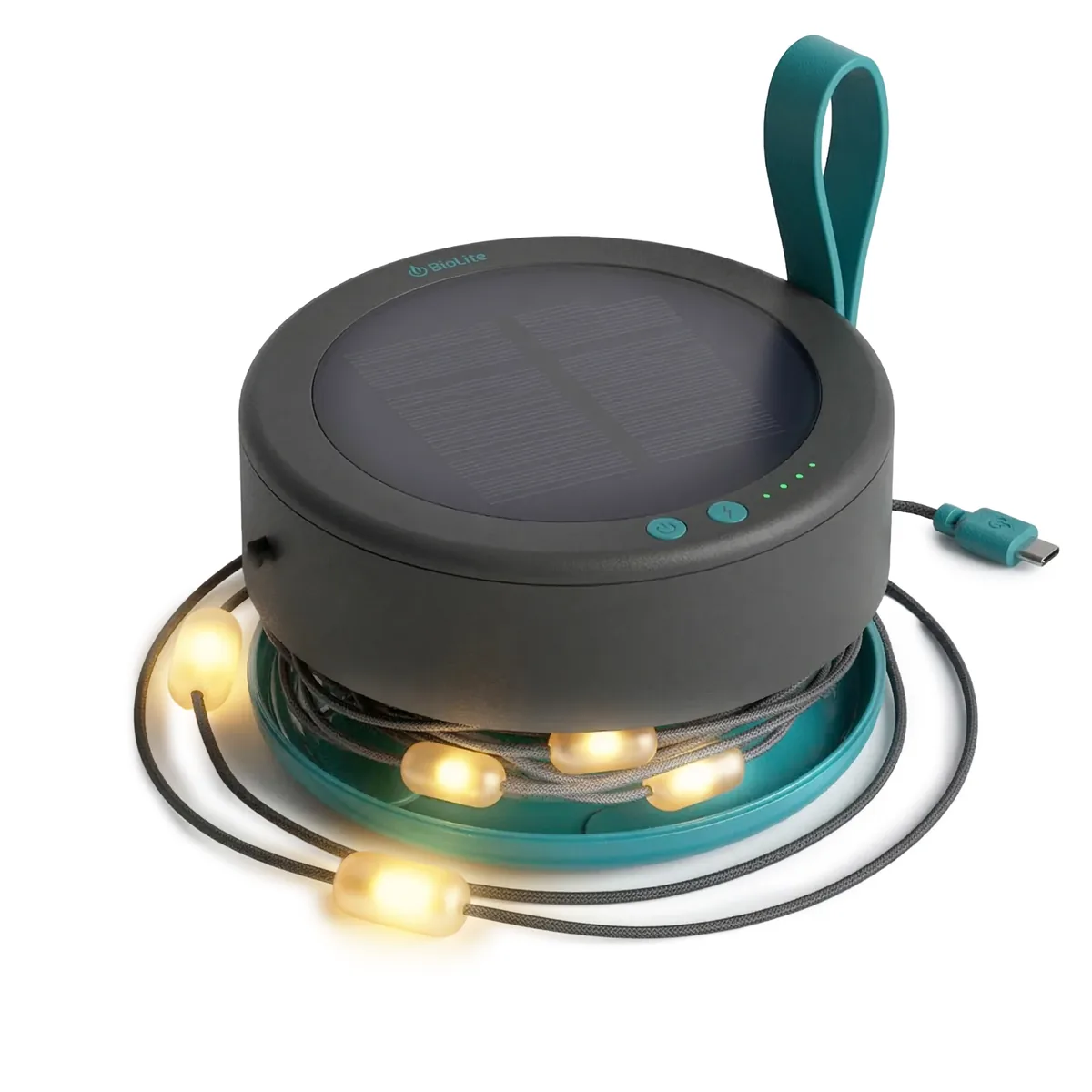
Renter fit: you only want patio lights, nothing else.
If the only thing you’d plug in is a string of lights, skip the power station. Solar string lights with a built-in battery cost a fraction of the price. BioLite’s 44 ft set ($99.95) has a detachable 4,000mAh battery rated for up to 40 hours, and it recharges by solar or USB-C. Many budget sets, like Slagawa’s 100 ft G40 kit at Lowe’s, add USB charging for cloudy stretches and carry an IP65 rating.
This is the honest answer to anyone shopping for a “solar power plug for outdoor lights”: you usually don’t need a plug at all.
Pros: cheap, light, no outlet needed. Cons: can only power the lights they came with, dim on cloudy weeks.
What can a solar power electrical outlet actually run?
A solar power electrical outlet can run anything whose wattage is below the inverter’s rating, for as long as the battery lasts. The quick rule: usable watt-hours divided by the device’s watts gives rough hours of runtime.
Here’s the simple math. Inverters lose some energy turning battery power into AC, so a common rough estimate is to plan on about 85% of the battery’s rated capacity when running AC devices. Check the exact watts on your device’s label.
| Device (typical draw, check your label) | 288Wh unit (~245Wh usable) | 504Wh unit (~430Wh usable) | Will it run? |
|---|---|---|---|
| LED string lights, 10W | ~24 hours | ~43 hours | Yes |
| Bluetooth speaker or Wi-Fi camera, 5-10W | 24+ hours | 43+ hours | Yes |
| Laptop, 60W | ~4 hours | ~7 hours | Yes |
| Box fan, 50W | ~5 hours | ~8.5 hours | Yes |
| Projector, 200W | ~1.2 hours | ~2 hours | Only on 300W+ units, briefly |
| Mini-fridge (compressor) | Short, and startup surge may trip a 300W unit | A few hours | Risky on small units |
| Space heater, 1,500W | No | No | No: exceeds output |
| Electric grill or kettle, 1,200-1,800W | No | No | Only on large units like AC240P |
That last group trips up a lot of buyers. A standard space heater pulls about 1,500W, which is more than double what a 600W unit can deliver, and it would drain a 504Wh battery in well under an hour even if it could run.
How fast can a balcony panel refill the battery?
Slower than the box suggests. A unit’s max solar input is the most it accepts, not what your balcony will deliver. A north-facing or shaded balcony may only get a fraction of the panel’s rating, and only for a few hours. As a rough guide, a 100W panel in good direct sun might add a few hundred watt-hours over a full sunny day. Plan to top up from a wall outlet indoors on cloudy weeks.
Three renter balconies, three different answers
The covered third-floor balcony with string lights and a laptop. You sit out after work, lights on, laptop open for an hour or two. That’s roughly 70W for a few hours, well within a 286 to 288Wh unit. The RIVER 3 Plus is the easy fit here, and the overhang keeps it dry.
The open rooftop-style deck that catches every storm. Nothing up there stays dry, and you don’t want to haul gear in every evening. This is where the IP65-rated AC60P earns its higher price. Lock the panel down well, because wind is worse up high.
The tiny Juliet balcony with room for a plant and nothing else. There’s no space for a box at all. Skip the outlet and clip a set of solar string lights to the railing, with the battery pack inside the door for USB charging on gray days.
Solar powered outdoor electrical outlet buying checklist
Before you buy any solar powered outdoor electrical outlet, check these, in this order:
- List what you’ll plug in and add up the watts. Keep the total under about 80% of the inverter’s continuous rating.
- Estimate hours with the runtime math above.
- Check the weather rating. If the spot gets rain, look for IP65, or plan to keep the unit under cover.
- Match the AC outlet count to your devices. Avoid daisy-chaining power strips outside.
- Check the solar connector and voltage. Anker’s C300 wants 11 to 28V on XT60; Jackery uses DC8020. A mismatched panel means buying an adapter.
- Check the charging temperature range if you live somewhere cold.
- Confirm it’s the AC version of the model (watch for “DC” in the name).
- Read your lease. Some buildings restrict what you can keep or hang on a balcony.
Outdoor solar electrical outlet vs. a real outdoor receptacle
An outdoor solar electrical outlet is a portable battery. A real outdoor receptacle is wired into the building by an electrician, and you can’t add one as a renter without your landlord. If your patio already has an outdoor outlet you’re allowed to use, that’s always cheaper than buying a battery. The solar option wins when there’s no outlet, or using it means running a cord through a door.
Setup on a balcony, and packing it away
Setting up an outdoor solar powered electrical outlet on a balcony takes about 15 minutes and no drilling. Here’s a renter-safe routine.
- Charge the unit fully indoors from the wall the first time.
- Hang or prop the panel where it gets the most direct sun. Secure it against wind.
- Place the power station under cover, off the floor where water pools, with room around the vents.
- Connect the panel with the brand’s solar cable or adapter.
- Plug in your devices and check the display for total watts.
- Route cords so no one trips, and keep plugs off wet surfaces.
Packing it away
- Unplug devices and disconnect the panel.
- Bring the power station inside when rain is coming (unless it’s IP65) and before freezing nights.
- Store the panel flat and dry.
- For long storage, many makers suggest keeping the battery partly charged and topping it up every few months; follow your manual.
Mistakes to avoid
Most disappointments with solar outlets come from wrong expectations about watts, weather or connectors.
- Buying a “solar outlet” stake for regular plug-in lights. Many cheap ones are low-voltage DC only.
- Leaving a non-rated unit in the rain. “Outdoor” in marketing doesn’t mean weatherproof.
- Expecting to run a heater, kettle or grill on a 300W to 600W unit.
- Buying the DC-only version of a model by accident.
- Using indoor power strips outside. If you need more outlets, use one rated for outdoor use and keep it dry.
- Ignoring wind. An unsecured panel on a high balcony can blow off and hurt someone below.
- Assuming the max solar input is what you’ll get. Shade and angle cut it a lot.
FAQ
Is there a solar powered outlet I can use outside without wiring?
Yes. A portable power station with AC outlets, charged by a solar panel, works as a solar powered outdoor plug with no wiring. Examples include the EcoFlow RIVER 3 Plus, Jackery Explorer 300 Plus and BLUETTI AC60P.
Can I leave a solar outlet outside in the rain?
Only if it has a water-resistance rating like IP65, such as BLUETTI’s AC60P or AC240P. Most compact power stations don’t list one, so keep them under cover or bring them in.
Can a solar powered outdoor outlet run a space heater?
No, not a standard one. A typical space heater draws about 1,500W, which is more than the 300W to 600W output of balcony-size units, and it would drain the battery quickly even on a larger station.
Do solar outlets work at night or on cloudy days?
They work at night from stored battery power. On cloudy days the panel recharges much more slowly, so plan to top up from a wall outlet indoors when needed.
Is an outdoor solar outlet legit, or a gimmick?
It depends on what’s being sold. Portable power stations from established brands are real AC outlets with published specs. Cheap stakes sold as “solar outlets” are often low-voltage DC lighting kits, so check for a 120V AC socket and a watt rating before buying.
The bottom line
For most renters, the best solar powered outdoor outlet is a compact power station: the EcoFlow RIVER 3 Plus if you can keep it covered, or the BLUETTI AC60P if it has to sit in the weather. If all you want is patio lights, solar string lights with a USB backup are cheaper and simpler. Add up your watts first, and you’ll pick the right size the first time.
Next step: if you’d rather feed your apartment with solar instead of running a battery, read our complete guide to solar panels for apartments before buying a panel.