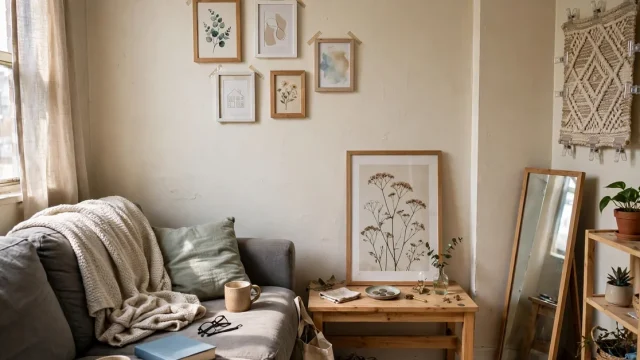

The most renter friendly ways to hang pictures are adhesive picture-hanging strips for light frames, removable hooks for small pieces, picture ledges and leaning for heavy art, and tension or freestanding systems when you can't touch the wall at all. Each method has a weight limit and a wall type it works best on. Pick the method by the weight of the art first, then by your wall, and you'll keep both your frames and your deposit safe.
Also read: Best No-Drill TV Wall Mounts for Renters (2026) · Portable Cooling for Renters – How to Keep a Rental Cool Without Installing AC

Quick answer
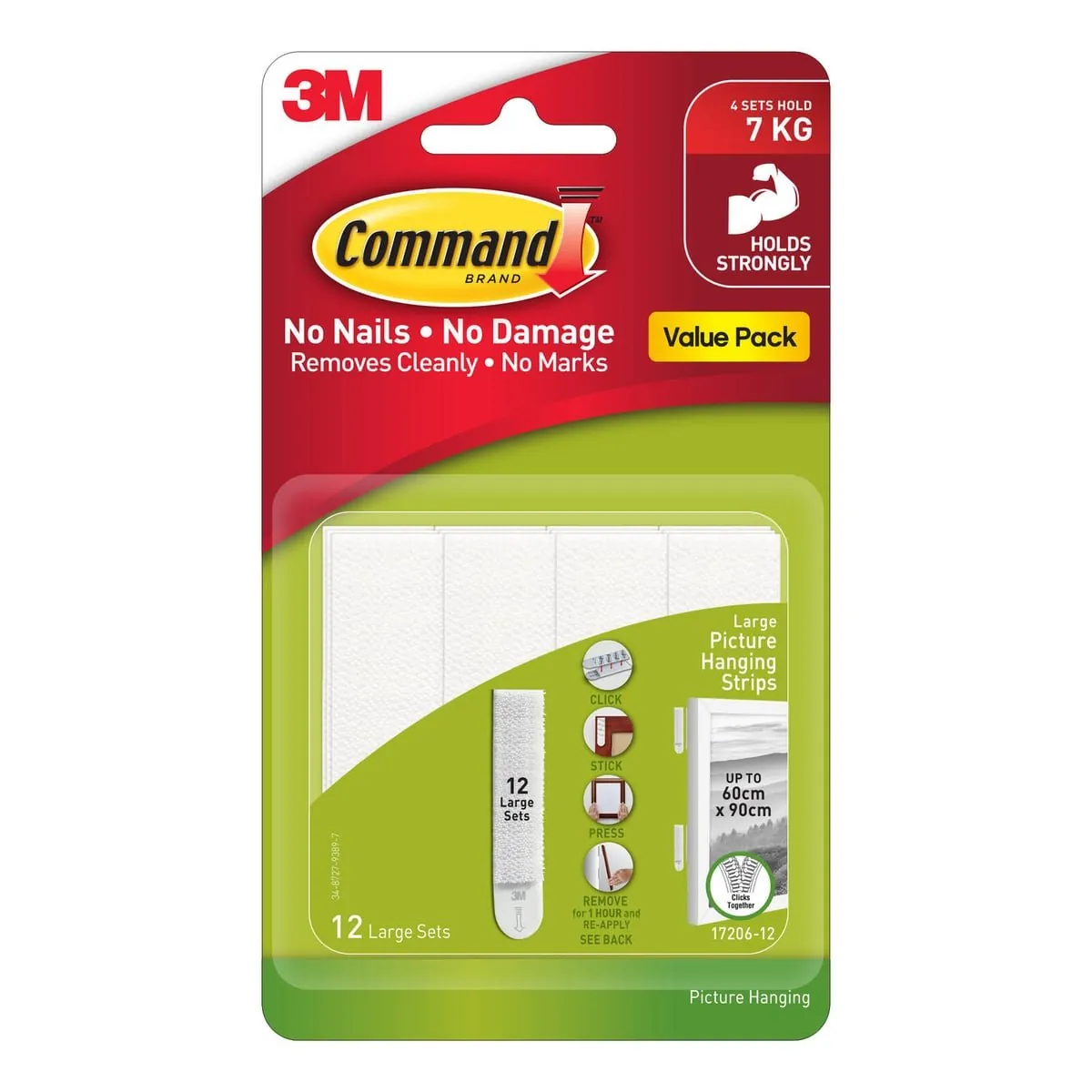
For frames up to about 16 pounds, use large picture-hanging strips on smooth, painted walls (four large pairs of Command strips hold 16 pounds and frames up to 24 by 36 inches, per 3M). For heavier art, lean it on a console or ledge. For posters, use poster strips or clip frames. Avoid adhesives on wallpaper, textured walls, and fresh paint, and never hang heavy frames over a bed with adhesive alone.
Key takeaways
- Adhesive strips fail most often because of wall prep, not weight. Clean the wall and press firmly.
- Wait 7 days after painting before using adhesive strips, per 3M's instructions.
- Leaning and ledges are the safest choice for heavy or valuable art.
- Remove adhesive strips by stretching the tab straight down along the wall, slowly.
- Check your lease. Some allow small nail holes, which can be safer than strips for heavy frames.
What renters can and can't do when hanging art
If you want to hang pictures without damaging walls, start with your lease. Most leases let you decorate as long as you return the walls in the same condition, minus normal wear and tear. What counts as damage varies, so read your lease before choosing a method.
| Lease situation | What it usually means | Safest choice |
|---|---|---|
| "No holes" or "no nails" | No nails, screws, or anchors | Adhesive strips, ledges, leaning, freestanding |
| "Small nail holes allowed" | Thin picture nails are fine, anchors are not | Small nails for heavy frames, strips for light ones |
| "Restore walls at move-out" | You fill and touch up anything you make | Any method, but plan your repair kit |
| Silent on hanging | Ambiguous | Ask in writing, or stick to no-hole methods |
Many renters don't realize that a tiny nail hole can be less risky than a strip that peels paint. A pinhole is easy to fill with spackle. A torn patch of paint the size of a credit card often needs a full repaint.
Every method compared
Here's how the main renter friendly ways to hang pictures compare. Weight limits come from manufacturer packaging; real-world results depend on your wall.
| Method | Holes? | Typical max weight | Best for | Wall types | Deposit risk |
|---|---|---|---|---|---|
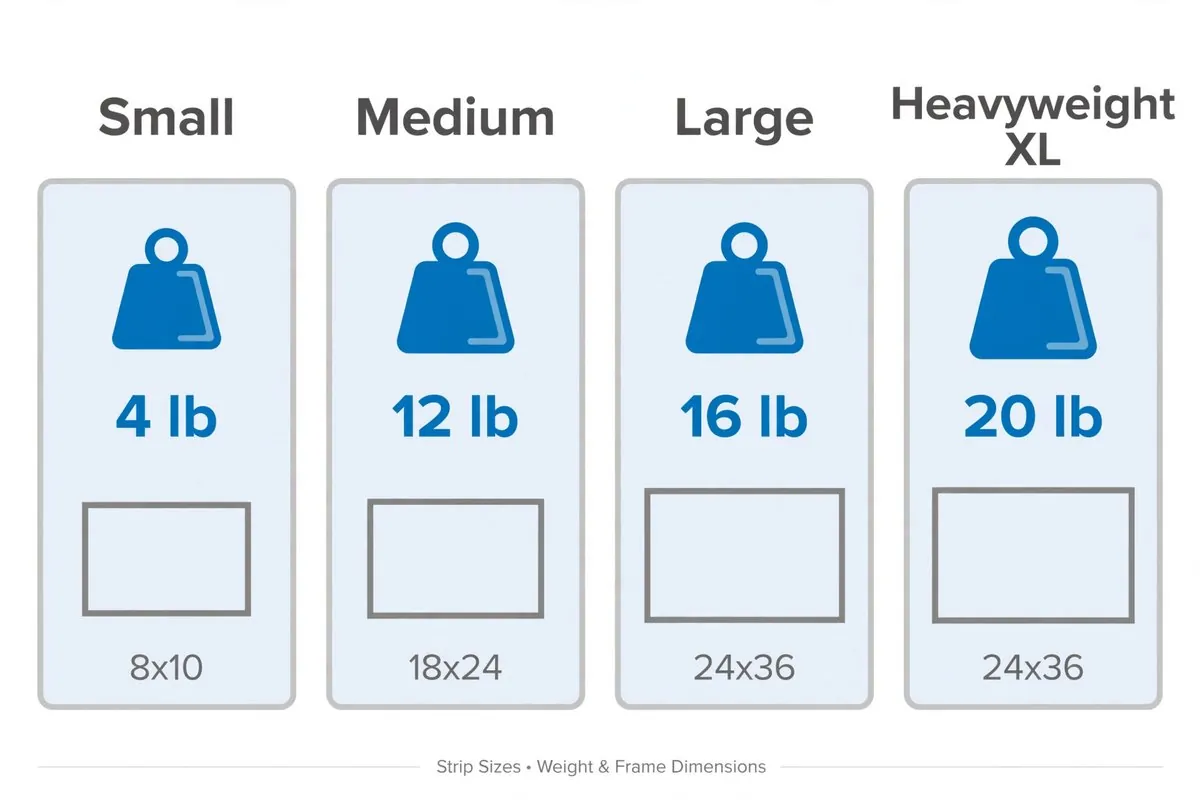
| Small picture strips | No | About 4 lb (4 pairs) | Small frames up to 8 x 10 in | Smooth painted | Low if removed correctly |
| Medium picture strips | No | About 12 lb (4 pairs) | Frames up to 18 x 24 in | Smooth painted | Low to medium |
| Large picture strips | No | About 16 lb (4 pairs) | Frames up to 24 x 36 in | Smooth painted | Medium |
| Heavyweight XL strips | No | About 20 lb (4 strips) | Large frames, two people to install | Smooth painted | Medium |
| Adhesive hooks | No | About 1 to 10 lb per hook, by size | Light frames with wire, wreaths | Smooth painted | Low to medium |
| Poster strips | No | Under 1 lb | Unframed posters | Smooth painted | Low |
| Picture ledge (freestanding or on furniture) | No | Varies | Rotating art, heavy frames | Any | None |
| Leaning on furniture or floor | No | Heavy art | Oversized pieces | Any | None |
| Tension pole display | No | Varies | Gallery displays, dividers | Floor to ceiling | Low |
| Small picture hanger nail | Tiny | Often 10 to 30 lb, check packaging | Heavy frames when allowed | Drywall, plaster | Low, easy to patch |
How to choose the right method for your wall and your art
Choose by weight first, then by wall surface, then by how often you like to rearrange.
- Weigh the art. Use a bathroom scale: weigh yourself, then weigh yourself holding the frame, and subtract.
- Check the wall. Run your hand over it. Smooth painted drywall is best for adhesives. Textured, brick, wallpaper, and freshly painted walls are not.
- Check the frame back. Strips need a flat, hard surface on the back of the frame. Paper backing and soft fabric won't hold.
- Pick the method from the table above, staying below the rated weight.
- Think about placement. Never use adhesive alone for heavy frames over beds, cribs, or seating.
Wall types and what works
- Smooth painted drywall: Strips, hooks, ledges on furniture, small nails if allowed.
- Textured walls: Adhesives grip poorly. Lean art or use a ledge on furniture.
- Brick and concrete: Brick clips for mortar-free edges, or freestanding options. Our How to Hang Things on a Brick Wall Without Drilling guide covers this in detail.
- Wallpaper: Don't use adhesives. They can tear the paper off. See Renter-Friendly Wallpaper: Peel-and-Stick Rules, Brands & Removal.
- Plaster: Adhesives can work on painted plaster, but old plaster can crumble. Test a small, hidden spot first.
How to hang pictures with Command strips, step by step
Picture-hanging strips work well when you prep the wall and follow the instructions closely. Most failures come from skipping steps.
- Clean the wall with isopropyl rubbing alcohol on a clean cloth. Don't use household cleaners, which can leave a slippery film. Let it dry.
- Remove sawtooth hangers or wire from the back of the frame so it sits flat.
- Press strip pairs together until they click.
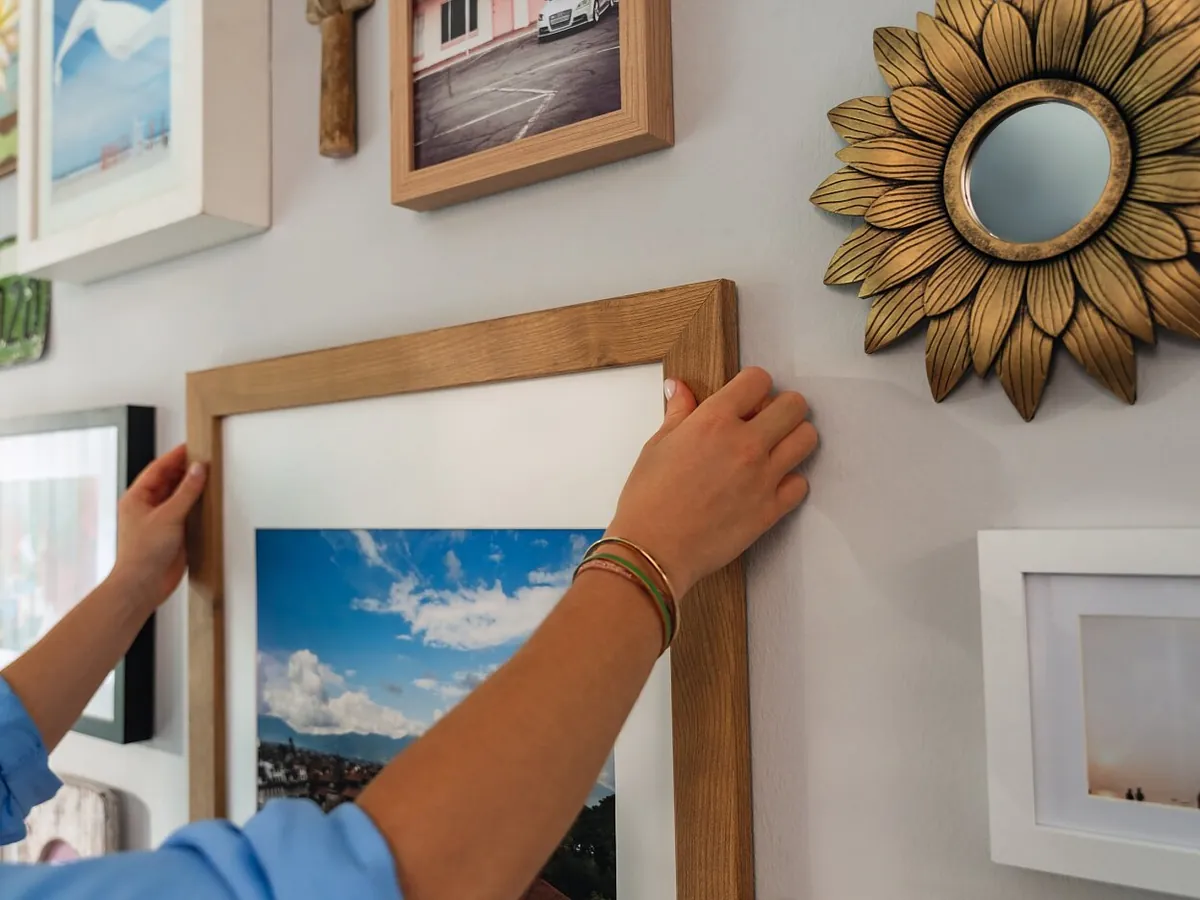
- Attach the strips to the frame, two on each side for larger frames, placed toward the top half.
- Press each strip on the frame for 30 seconds.
- Mark your spot with painter's tape and a level.
- Peel the wall liner, place the frame, and press firmly for 30 seconds.
- Remove the frame by pulling from the bottom corners, then press each strip on the wall for another 30 seconds.
- Wait one hour before hanging the frame back on the strips.
3M also says to wait 7 days after painting before you use strips, and not to use them on wallpaper or over beds.
How to hang posters with Command strips
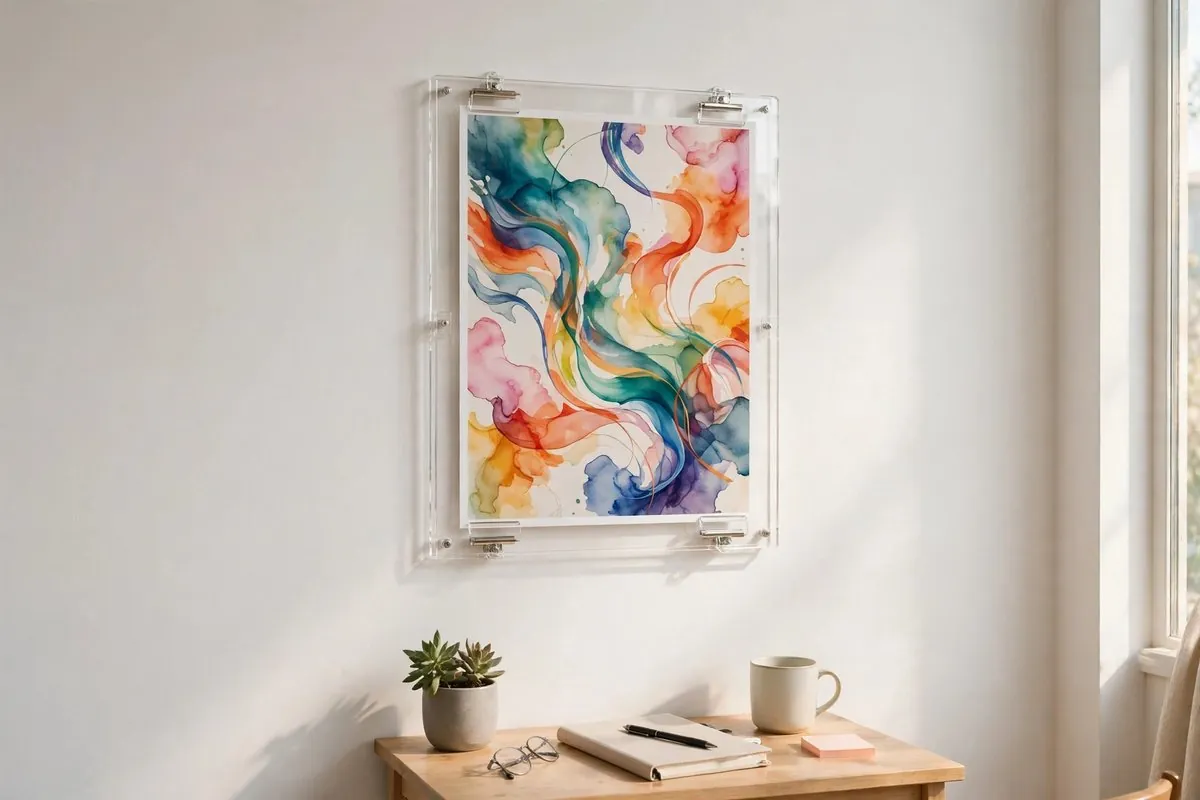
Command strips for posters work differently. Use poster strips, which are thin and light, and place them on each corner and at the middle of each long edge for bigger posters. If you're worried about damaging a valuable print, use a clip frame or a magnetic poster hanger and hang that frame with picture strips instead.
How to hang art without nails: ledges, leaning, and rails
For heavy, valuable, or frequently swapped art, skip the wall entirely. These options carry zero deposit risk.
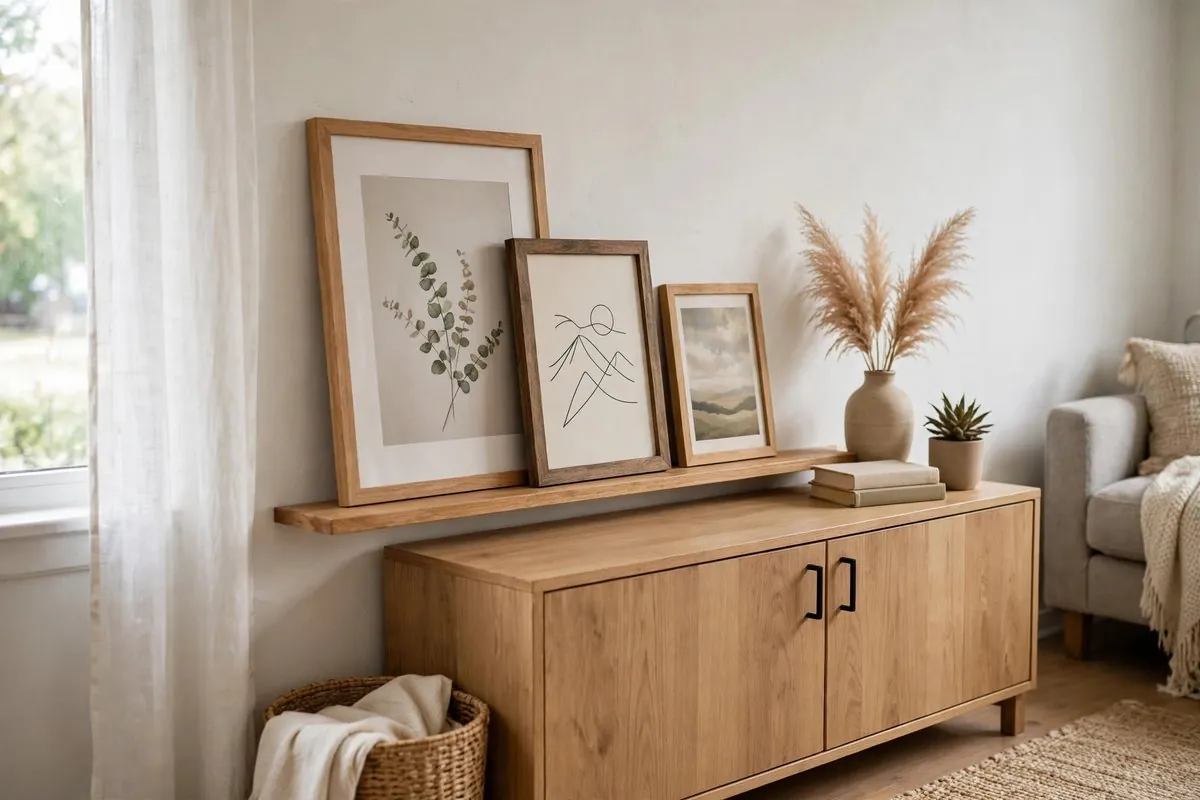
Leaning on furniture
Lean large framed art on a console, dresser, or bookcase. Layer two or three frames of different sizes for a relaxed look. Put a small piece of non-slip shelf liner or museum putty under the bottom edge so it doesn't slide.
Picture ledges on furniture
A freestanding ledge or a shelf on top of a low cabinet holds rotating art. You can change the display weekly with no new holes.
Floor leaning
Oversized art looks deliberate leaning on the floor against a wall. Use felt bumpers on the top corners to protect the paint, and keep it out of walkways. In homes with kids or pets, anchor it some other way or choose a lighter frame.
Tension poles and freestanding displays
A floor-to-ceiling tension pole can hold shelves or small frames without touching the walls. Before you rely on one, read What to Check Before Using a Tension Pole Shelf in an Apartment. A freestanding room divider can double as a display surface, too. See How to Install a Freestanding Room Divider in a Rental Apartment.
How to hang tapestries, string lights, and other wall decor
Not everything on your walls is a framed picture. These lighter pieces have their own no-nail tricks.
Tapestries and fabric hangings
Fabric is light but wide, so it needs several attachment points. Use clear adhesive hooks along the top edge, spaced every 12 to 18 inches, and hang the fabric from a thin wooden dowel or curtain rod resting on the hooks. That spreads the load and keeps the fabric flat. Avoid pushpins if your lease says no holes.
String lights
Use small adhesive clips made for cords, spaced about every 12 inches. Plug the lights into a smart plug so you can switch them from your phone. That also stops the cord from being yanked off the wall when you reach for a switch. Our What Is a Smart Plug? How It Works & What Renters Can Do With One guide explains how.
Clocks and lightweight mirrors
Check the weight. Many wall clocks weigh under 3 pounds and work on a single medium adhesive hook with a wire hanger. Small mirrors under the strip rating can go on picture strips, but keep them away from beds and doorways where they could be knocked.
Shelves for art and objects
Small adhesive shelves exist, but their limits are low and they're easy to overload. A freestanding shelf or bookcase is usually a safer place for heavier objects. If you do want something on the wall, read the weight limits in No-Drill Wall Mounts: What Holds Without Studs or Drilling first.
Why adhesive strips fail even below the weight limit
Strips usually fail because of the wall surface, the frame back, temperature, or humidity. The weight rating assumes ideal conditions.
| Cause | What happens | Fix |
|---|---|---|
| Dusty or greasy wall | Adhesive never bonds | Clean with rubbing alcohol first |
| Fresh paint (under 7 days) | Strip pulls paint or slides | Wait at least 7 days |
| Textured or matte flat paint | Small contact area | Use a ledge or lean instead |
| Bathroom humidity | Adhesive softens | Use products rated for wet areas |
| Paper-backed frame | Paper tears away | Mount on a hard frame edge or use a ledge |
| Cold exterior wall | Weaker bond | Install at room temperature |
| Overloading | Slow creep, then sudden fall | Stay well under the rated weight |
Customer reviews back this up. Many buyers say their frames held for months, while others report frames falling below the weight limit and breaking glass. The difference is almost always prep and surface. For bathroom upgrades, see Renter-Friendly Bathroom Upgrades: No-Drill Towel Bars, Hooks & More.
How to remove picture strips without damaging paint
Removal is where most deposit damage happens. Go slowly and stretch the strip, never pull it away from the wall.
- Lift the frame off the strips by pulling up and away from the bottom corners.
- Find the strip's pull tab.
- Hold the base of the strip against the wall with one finger.
- Stretch the tab straight down along the wall, slowly, keeping it flat against the wall. Don't pull it toward you.
- If a strip snaps, warm it with a hair dryer for 20 to 30 seconds and try again, or use dental floss to saw behind it.
- Wipe any residue with a little rubbing alcohol.
Our Command Strips: Hooks, Shelves & Weight Limits (and Safe Removal) guide covers hooks and shelves too.
Renter friendly ways to hang pictures in every room
Each room has its own surfaces, humidity, and safety concerns, so the best method changes as you move through the apartment.
| Room | Common surface | Best method | Avoid |
|---|---|---|---|
| Living room | Smooth painted drywall | Strips for light frames, lean large art on a console | Heavy frames above the sofa on adhesive |
| Bedroom | Painted drywall | Ledge on a dresser, light frames on strips beside the bed | Anything heavy or glass over the bed |
| Hallway | Painted drywall, high traffic | Strips with small, light frames | Big frames people can bump |
| Kitchen | Painted walls, grease | Clean well, use light frames or magnetic boards | Strips near the stove |
| Bathroom | Humid, tile or semi-gloss paint | Products rated for wet areas, waterproof prints | Standard strips near the shower |
| Kids' room | Any | Unbreakable frames, acrylic instead of glass | Glass frames in reach |
Bedrooms and kids' rooms need extra care
Swap glass for acrylic in any frame that could fall near a bed or play area. Acrylic is lighter, which also helps strips hold, and it won't shatter if something drops. For other safety basics, see How to Prevent Furniture Tip-Overs in a Rental Apartment.
When a small nail is the safer choice
Sometimes the most renter-friendly option is a tiny picture-hanger nail, if your lease allows it. That surprises people, but here's why:
- A thin nail leaves a pinhole that a dab of spackle hides in a minute.
- A failed adhesive strip can tear off paint and the paper face of the drywall, which needs sanding, priming, and repainting.
- Heavy frames on strips can creep and fall, damaging the frame, the floor, and whatever's underneath.
If your lease allows small holes, use a picture-hanger nail rated for your frame's weight for anything over about 12 pounds. Keep a small move-out kit: lightweight spackle, a putty knife, and a fine sanding sponge. Ask your landlord for the paint color name if you need a touch-up.
If your lease says no holes at all, don't risk it. Lean or shelve heavy pieces instead.
Real renter scenarios
The first apartment with bare walls
Leah moves into a studio with a strict no-holes lease and wants her space to feel finished. She buys a variety pack of picture strips, hangs five small frames as a gallery wall above her desk, and leans one large print on a low bookcase. Total spend is about $25. At move-out, she stretches every strip down, wipes the wall with rubbing alcohol, and leaves no marks.
The heavy mirror and big canvas
Omar has a 25-pound framed mirror and a 30 by 40 inch canvas. Both are over the large-strip rating. He leans the mirror against the bedroom wall on a non-slip pad, with felt bumpers on the top corners, and sets the canvas on a long console in the living room. Read Can You Hang a Heavy Mirror Without Drilling? Load and Safety Limits for more on heavy pieces.
The poster collector
Sam has a dozen unframed concert posters and rotates them every few months. Poster strips on the corners work for cheap prints. For the rare ones, Sam uses lightweight clip frames hung with medium picture strips, so the posters never touch adhesive.
Gallery walls without nails
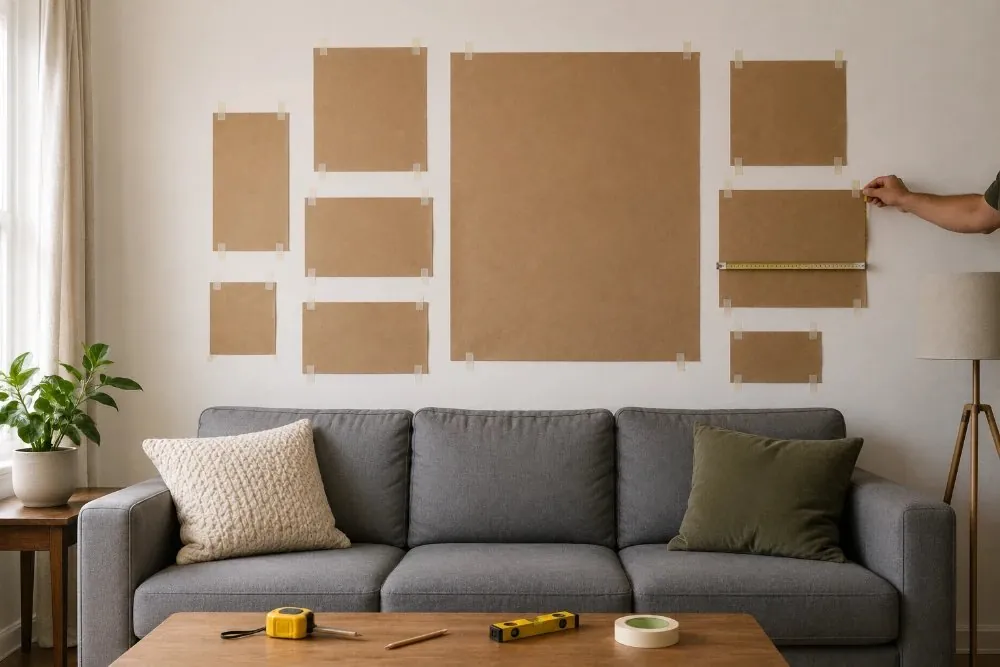
A gallery wall works great with strips as long as every frame stays light. Plan it on the floor first.
- Lay the frames on the floor and arrange them until you like the layout.
- Trace each frame on kraft paper, cut out the shapes, and tape them to the wall.
- Mark where the strips go on each paper template.
- Replace templates with frames one by one, starting from the center.
- Keep 2 to 3 inches between frames for a tidy look.
Mix frame sizes, but keep each one under its strip rating. For a balanced look, line up the bottom edges of the frames in the lowest row. Or center the whole group about 57 inches from the floor, a common gallery height. If you're hanging above a sofa or console, leave 6 to 10 inches between the furniture and the lowest frame. For ideas on decals and panels that pair with art, read Peel-and-Stick Wall Decals: Will They Damage Rental Paint? and Renter-Friendly Wall Panels & Wood Paneling (Peel-and-Stick).
What does it cost to hang pictures without nails?
Most renters spend $10 to $40 for a room's worth of hanging supplies. Prices checked November 2026; they vary by pack size and retailer.
| Item | Approx. price |
|---|---|
| Picture-hanging strips, variety pack | $8 to $15 |
| Large strips, bulk pack | $15 to $30 |
| Poster strips | $4 to $8 |
| Adhesive hooks, multipack | $6 to $15 |
| Rubbing alcohol and cloth | $3 to $5 |
| Freestanding picture ledge | $20 to $60 |
| Spackle and small putty knife (move-out kit) | $6 to $10 |
Mistakes to avoid when hanging art in a rental
- Using strips on fresh paint, wallpaper, or textured walls.
- Skipping the alcohol wipe. It's the most important step.
- Hanging heavy frames over a bed with adhesive only.
- Pulling strips toward you instead of stretching them down.
- Using strips on valuable or irreplaceable art. Lean it instead.
- Forgetting to check the lease. Sometimes a small nail is allowed and safer.
No-drill wall guides in this series
This guide is the hub for our walls, shelves, and decor articles:
- Command Strips: Hooks, Shelves & Weight Limits (and Safe Removal)
- How to Hang Things on a Brick Wall Without Drilling
- No-Drill Wall Mounts: What Holds Without Studs or Drilling
- No-Drill Wall Decor Ideas for Renters (Tenant-Friendly)
- How to Secure a Bookshelf to the Wall Without Drilling
- How to Hide Cords on a Wall Without Drilling
- Renter-Friendly Wallpaper: Peel-and-Stick Rules, Brands & Removal
- Can You Put Peel-and-Stick Wallpaper Over Wallpaper?
- Peel-and-Stick Wall Decals: Will They Damage Rental Paint?
- Renter-Friendly Wall Panels & Wood Paneling (Peel-and-Stick)
- Renter-Friendly Bathroom Upgrades: No-Drill Towel Bars, Hooks & More
- How to Hang Window Boxes Without Drilling (Brick, Siding & Rails)
- How to Install Over-the-Door Storage Without Drilling
- How to Install a Freestanding Room Divider in a Rental Apartment
- What to Check Before Using a Tension Pole Shelf in an Apartment
- Related: How to Mount a TV Without Drilling (5 Renter Methods)
FAQ
What are renter friendly ways to hang pictures?
Adhesive picture-hanging strips, removable hooks, picture ledges on furniture, leaning art, and tension or freestanding displays. Pick by the art's weight and your wall type.
Can Command strips for posters damage walls?
They can if the wall is freshly painted, textured, or wallpapered, or if you pull the strip away from the wall during removal. On clean, smooth, painted walls, stretching the tab straight down usually removes them cleanly.
How much weight can picture-hanging strips hold?
Per 3M packaging, four pairs of small strips hold about 4 pounds, medium about 12 pounds, and large about 16 pounds. Heavyweight XL strips are rated around 20 pounds. Stay below the rating for real-world use.
How can I hang art without nails on a textured wall?
Adhesives grip poorly on texture. Lean the art on furniture, use a freestanding ledge, or ask your landlord about a small picture nail.
Can I hang framed art over my bed with strips?
3M advises against hanging items over beds with its picture strips. Use a ledge, lean the art on a headboard shelf, or hang only very light, unbreakable pieces.
What should I do before move-out?
Remove all strips by stretching them down, clean residue with rubbing alcohol, fill any small nail holes with spackle, and take dated photos of every wall.
Conclusion
The best renter friendly ways to hang pictures match the method to the art's weight and your wall. Use strips for light frames on smooth paint, lean or shelve anything heavy or valuable, and remove everything slowly when you move. Your next step: read Command Strips: Hooks, Shelves & Weight Limits (and Safe Removal) for weight limits on hooks and shelves.
Sources
- 3M Command Medium and Large Picture Hanging Strips product page
- 3M Command picture hanging strip instructions (multimedia.3m.com)
- Office Depot: Command Large Picture Hanging Strips usage tips