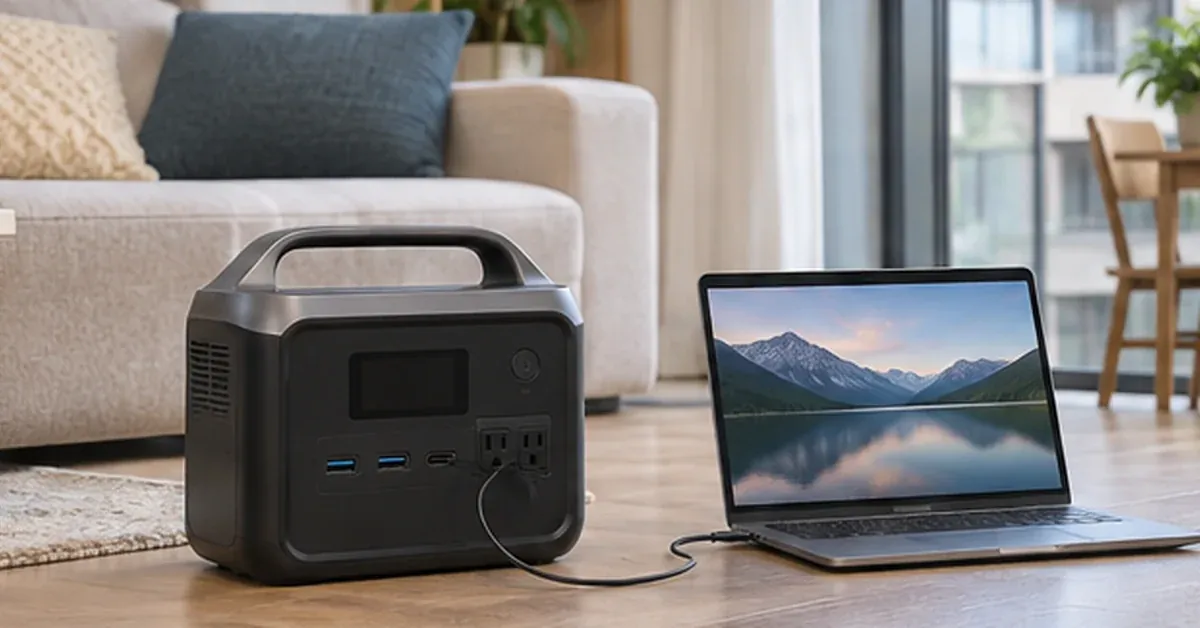
A portable power station runtime calculator answers one question: how many hours will this battery run my stuff? The quick formula is battery capacity in watt-hours × 0.85, divided by the total watts of your devices. A 1,000 Wh station running a 100-watt load lasts about 8.5 hours. Use the calculator below to plan for your fridge, router, laptop, and lights during an outage.
Also read: Best Solar Powered Outdoor Outlets for Balconies & Patios (2026) · What States Allow Plug-In Solar? 2026 State-by-State Tracker · Balcony Solar for Renters: What It Is, Laws, Cost & Setup · Best 200W Portable Solar Panels for Apartments (2026) : HQST 200W Ultra-Light Foldable Portable Solar Panel and 5 Rivals
Quick answer
Runtime (hours) ≈ Battery capacity (Wh) × 0.85 ÷ Total device watts.
- 500 Wh station, 60 W laptop + 15 W router (75 W): about 5.7 hours
- 1,000 Wh station, 100 W TV: about 8.5 hours
- 1,024 Wh station, typical fridge: roughly 7 hours or more, depending on the fridge's average draw
The 0.85 factor covers inverter and electronics losses when you use AC outlets.
The calculator
Paste this into a Custom HTML block in WordPress. It runs in the browser and needs no plugin.
<div id="ps-calc" style="max-width:520px;font-family:Arial,sans-serif;border:1px solid #ddd;padding:16px;border-radius:8px">
<h3 style="margin-top:0">Power Station Runtime Calculator</h3>
<label>Battery capacity (Wh)<br><input id="ps-wh" type="number" value="1000" min="1" style="width:100%"></label><br><br>
<label>Total device load (watts)<br><input id="ps-w" type="number" value="100" min="1" style="width:100%"></label><br><br>
<label>Output type<br>
<select id="ps-eff" style="width:100%">
<option value="0.85">AC outlets (about 85% efficient)</option>
<option value="0.95">DC / USB outputs (about 95% efficient)</option>
</select></label><br><br>
<button onclick="psCalc()" style="padding:8px 16px">Calculate</button>
<p id="ps-out" style="font-weight:bold;margin-bottom:0"></p>
</div>
Portable power station runtime calculator: how the formula works
Battery capacity is listed in watt-hours (Wh). Your devices use watts (W). Dividing gives hours, but some energy is lost.
- AC outlets go through an inverter, which wastes some energy as heat. Planning formulas used by brands like Anker, Jackery, and EcoFlow commonly assume about 85% efficiency.
- DC and USB outputs skip the inverter, so they're more efficient, often around 95%.
- Battery age and temperature reduce usable capacity over time and in the cold.
Formula: Runtime = Wh × efficiency ÷ watts. That's how you convert watt hours to hours of use.
Typical apartment loads
| Device | Typical watts | Note |
|---|---|---|
| Wi-Fi router + modem | 10 to 25 W | Keeps you online if the internet still works |
| Laptop | 45 to 90 W | Charge, then unplug to stretch runtime |
| Phone charging | 5 to 20 W | Use USB outputs |
| LED lamp | 8 to 15 W | |
| CPAP (no humidifier) | 30 to 60 W | Check your device's label |
| TV | 50 to 150 W | |
| Mini fridge | Average 30 to 60 W over a day | Compressor cycles on and off |
| Full-size fridge | Average roughly 100 to 200 W over a day | Startup surge can be much higher |
| Box fan | 50 to 100 W |
Check your device labels for exact numbers. For fridges, use the yearly kWh on the energy label: divide by 365 for daily kWh, then by 24 for average watts.
Worked examples
Work-from-home outage. Laptop (65 W) + router and modem (20 W) = 85 W. A 500 Wh station: 500 × 0.85 ÷ 85 ≈ 5 hours.
Evening essentials. Two LED lamps (20 W) + router (20 W) + phone charging (10 W) = 50 W. A 300 Wh station: 300 × 0.85 ÷ 50 ≈ 5.1 hours.
Fridge. A fridge rated 400 kWh per year averages about 46 W. A 1,024 Wh station: 1,024 × 0.85 ÷ 46 ≈ 19 hours. In real use, door openings and warm rooms shorten that.
Watt-hours vs watts: don't mix them up
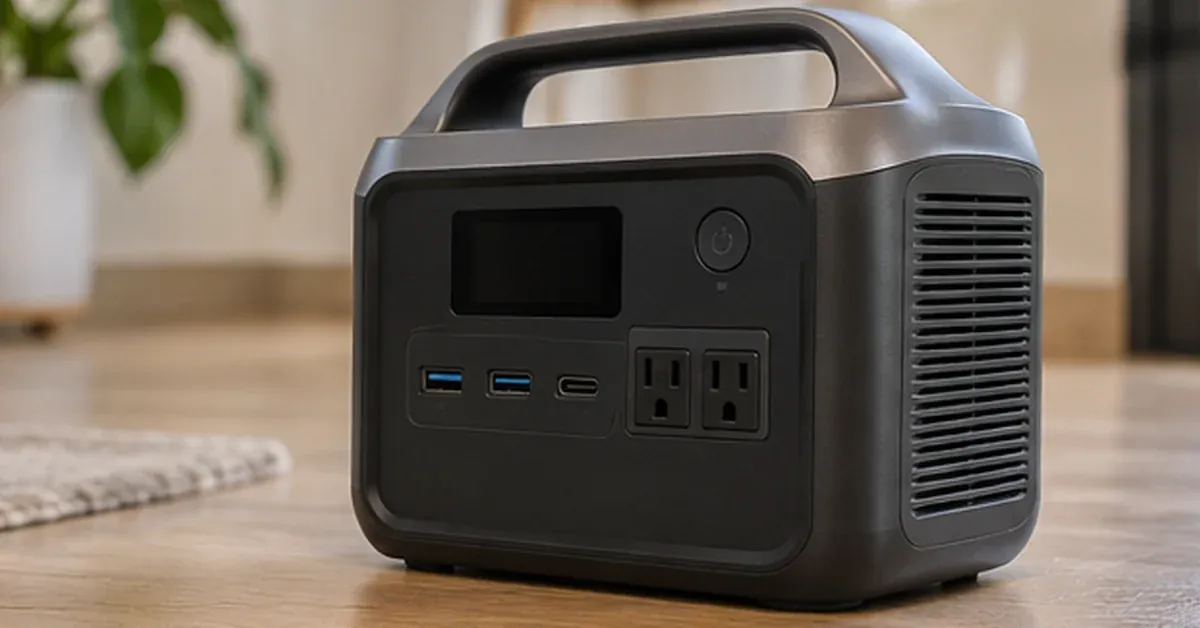
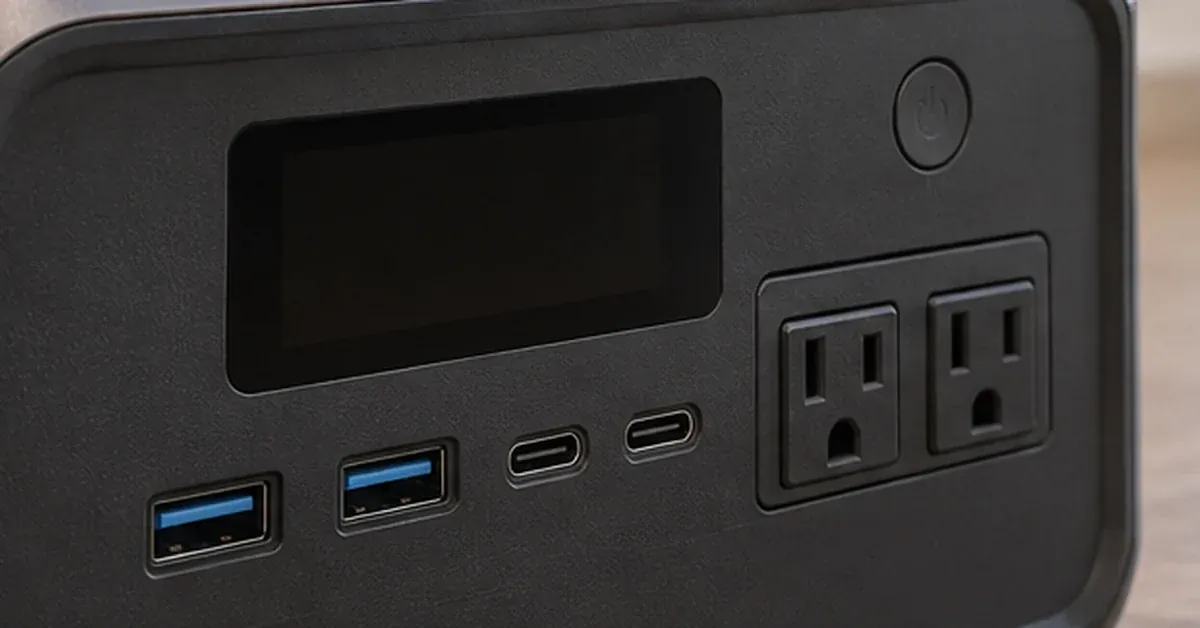
A station's watt rating (like "1,000 W") is the most it can deliver at once. Its watt-hour rating is how much energy it stores. You need both: enough watts to start your devices, and enough watt-hours to run them for as long as you need.
Recharging with solar
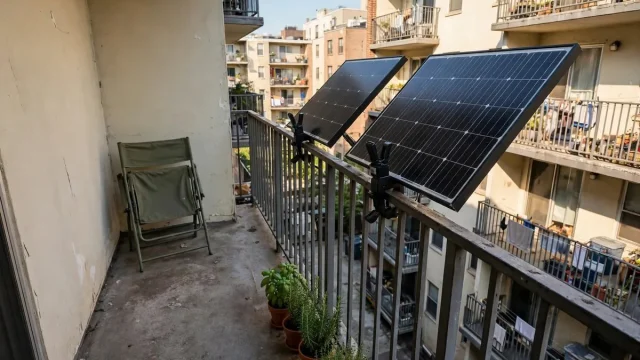
If you have a balcony and the right panel, you can recharge during the day. See How to Connect Portable Solar Panels to an Apartment Power Station Safely and compare with plug-in kits in Plug-In Balcony Solar vs Portable Solar Power Stations: What Is Different?.
How to size a power station for your apartment
Work backward from what you need to keep running and for how long.
- List essentials and their watts.
- Decide on hours you want to cover, such as an 8-hour overnight outage.
- Multiply each device's watts by its hours of use to get watt-hours.
- Add them up and divide by 0.85 for AC use.
- Add a margin of 20% or more for battery aging and cold rooms.
Example: router 20 W × 8 h = 160 Wh, two lamps 20 W × 4 h = 80 Wh, laptop 65 W × 3 h = 195 Wh. Total 435 Wh. Divide by 0.85 = about 512 Wh. Add 20% = about 615 Wh. A 600 to 700 Wh station fits.
| Need | Typical station size |
|---|---|
| Phones, router, lights for a few hours | 250 to 500 Wh |
| Work-from-home day | 500 to 1,000 Wh |
| Fridge plus essentials overnight | 1,000 to 2,000 Wh |
| Medical device backup | Ask your doctor and device maker for runtime needs |
Also check the station's continuous watt rating and surge rating. A fridge can draw several times its running watts for a moment when the compressor starts.
Apartment safety tips
- Keep the station indoors on a dry, hard surface with airflow.
- Don't run fuel generators indoors or on balconies. Read Can You Use a Generator in an Apartment? Safety Rules.
- Don't plug a power station into a wall outlet to "backfeed" the apartment.
- Follow the maker's charging temperature limits.

Mistakes to avoid
- Mixing up watts and watt-hours. Watts are how fast a device uses power. Watt-hours are how much energy the battery holds.
- Using the full battery rating. Inverter and conversion losses mean you usually get roughly 80% to 90% of the rated watt-hours. The calculator above includes this.
- Ignoring surge power. Fridges and some pumps draw a short spike when they start. The station's surge rating has to cover it.
- Using a fridge's label watts as constant draw. Compressors cycle on and off, so real average draw is often much lower. Measure with an energy-monitoring plug if you can.
- Planning around a gas generator instead. Never run fuel generators indoors or on balconies.
Questions
Frequently asked questions.
How do I calculate power station runtime?
Multiply the battery's watt-hours by about 0.85 for AC use, then divide by your devices' total watts.
How long will a 1,000 Wh power station run a fridge?
Often 10 to 20 hours for an efficient fridge, depending on its average draw, room temperature, and door openings.
Why is my runtime shorter than the formula?
Inverter losses, cold temperatures, battery age, and devices that draw more than their label suggests all reduce runtime.
Is DC output more efficient than AC?
Yes. DC and USB outputs skip the inverter, so they usually waste less energy.
Conclusion
A portable power station runtime calculator turns a confusing spec sheet into a simple plan: watt-hours × 0.85 ÷ watts. List your essentials, total their watts, and size your station with some margin. For the bigger renter solar picture, see Solar Panels for Apartments & Renters: Complete Guide.
Sources
- Anker SOLIX: How long will a power station last (0.85 runtime formula)
- EcoFlow: Battery run time calculator
- Cygnett: Portable power station runtime and fridge energy label method
FAQPage JSON-LD Schema